The reintegration of 5 million veterans may be Ukraine’s next major battle: Results from a recent survey in Ukraine
Posted Friday, 11 Jul 2025 by Júlia Palik

While discussions of a ceasefire remain clouded by , Ukrainian soldiers continue to fight on the frontlines. Once the fighting on the ground ends, these women and men will likely face their next battle in reintegrating into civilian lives.
At the time of this writing, are defending Ukraine, approximately 68,000 women (compared to 16,500 in 2014). suggest that up to 5 million veterans, including their families, will require reintegration support 鈥� an unprecedented case load and reintegration challenge.
Key points
- Ukraine will need to reintegrate up to and their families 鈥� approximately 10% of its population 鈥� once the war ends.
- We surveyed a representative sample of more than a thousand Ukrainians from unoccupied territories and found that they see access to psychological support for veterans 鈥� both for male and female veterans 鈥� as the greatest war-related challenge.
- Although women have been integrated聽into the armed forces, gaps remain in addressing their distinct reintegration needs, including social stigma, exposure to conflict-related sexual violence, and increased caregiving responsibilities upon returning to civilian life.
- Access to physical rehabilitation was ranked the second most pressing war-related challenge, which points to the need to make Ukraine鈥檚 post-war infrastructural rehabilitation barrier free.
Previous research on veterans' reintegration challenges
Returning veterans face two major challenges: processing their war-time experiences and reestablishing their civilian lives. A 鈥� dominated by the US and Western samples 鈥� highlights the mental health struggles of returning soldiers. Studies show high rates of ), and amongst veterans. The mental health legacies of war can have severe impact on veterans鈥� family and economic lives: found that intimate partner violence (IPV) can be prevalent in families with veterans suffering from war-related PTSD, but the evidence is weak and data is scarce. suggests that war-related PTSD might not only increase the risk of perpetration, but can make former soldiers more vulnerable to IPV. Employment outcomes for veterans : those in higher-ranking roles, such as intelligence officers or drone operators, tend to secure well-paid jobs, while younger combatants in infantry roles often earn lower wages. Importantly, not all veterans face the same challenges upon return to civilian lives: Some studies demonstrate high levels of amongst veterans and show that can foster social reintegration.
Findings from a recent a survey in Ukraine
To understand what challenges veterans might face upon return to their civilian lives, we conducted a large online survey of Ukrainians, focusing on their聽attitudes toward the role of women. The survey was commissioned by Norad and collected in 18 December 2024鈥�6 January 2025. The questionnaires were聽 administered by a local survey agency, Info Sapiens (see our previous surveys with Info Sapiens or their the invading Russian forces). The present survey included 1,354 respondents (55% women, mean age 44) from all unoccupied areas of Ukraine. About 10.6% of the respondents reported combat experience (17.3% of men, 5% of women). We include more information about the survey at the end of this post.
We asked participants to rate, on a scale from 1 to 5 (1 = not at all, 5 = to a very high extent), the extent to which they believe men and women veterans encounter challenges upon returning from war in the following areas:
- Access to jobs, education and vocational training
- Access to housing and social benefits
- Reestablishing social relationships (e.g., with family, friends and colleagues)
- Access to physical rehabilitation and healthcare services
- Coping with the psychological impact of wartime experiences
Figure 1 depicts the mean ratings for each category, suggesting that coping with the psychological impact of war among veterans is perceived as the biggest challenge by surveyed Ukrainian respondents. The respondents believe that access to psychological support will be more challenging for men (vs women) veterans, a difference that is statistically significant.[1] Respondents perceived access to housing and social benefits as the second biggest challenge for women veterans and access to physical rehabilitation for men veterans. In general, the surveyed Ukrainians viewed employment challenges as moderate. This is surprising, because in 2024 the Ukrainian Veterans Fund that over 30% of veterans no longer serving in the army were unemployed.
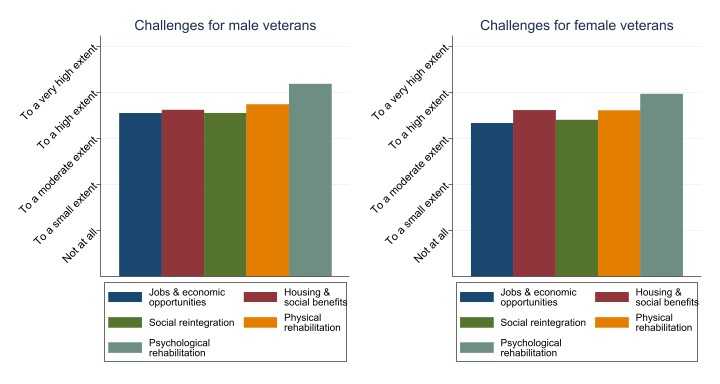
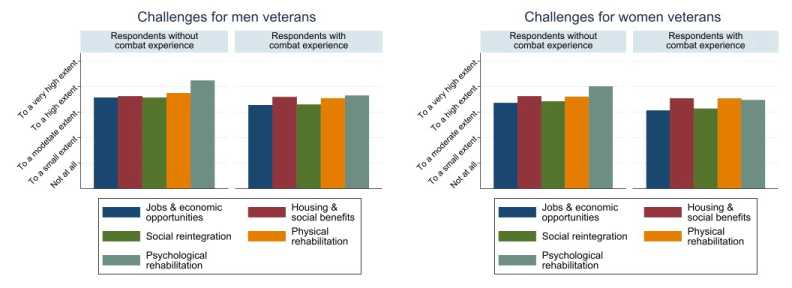
Figure 2 displays results by differentiating between respondents with and without combat experience. The figure shows that respondents without combat experience rated veterans鈥� access to psychological support and social reintegration (i.e. reestablishing relations with family, friends and colleagues) significantly more challenging compared to respondents with combat experience. At the same time, respondents without combat experience rated veterans鈥� access to jobs and economic opportunities significantly less challenging compared to respondents with combat experience.[2]
Implications for Ukrainian veterans' reintegration
While these analyses are preliminary, we believe they already point to three important factors that reintegration programs should take into account.
1. Stereotypes of veterans, both positive and negative, can hinder employment opportunities
Our data suggests that psychological rehabilitation is deemed by respondents to be key for veterans. Civilians鈥� perceptions of veterans, both positive and negative, can shape veterans鈥� employment prospects. found that senior decision-makers were unlikely to hire veterans, believing them to be unfit for business roles and workplace cultures.
Civilians鈥� perceptions of veterans, both positive and negative, can shape veterans鈥� employment prospects.
These stereotypes are gendered: Women veterans in the US have than both veteran men and civilian women. A examining the experiences of women veterans who had a civilian job found that they were simultaneously perceived as too 鈥榯ough鈥�, but their military experience was also dismissed, leaving them feeling disregarded and unable to professionally progress.
Information campaigns and dialogue sessions, both with community members and future employers, can help Ukrainian veterans to escape the negative effects of (even positive) labelling and find adequate post-war employment.
An 11-experiment study found that because respondents perceive veterans to be less selfish and hence funnel veterans into careers that are based on serving others, such as firefighter or public school teacher 鈥� jobs that tend to be lower paying. Information campaigns and dialogue sessions, both with community members and future employers, can help Ukrainian veterans to escape the negative effects of (even positive) labelling and find adequate post-war employment.
2. Gender equality in the military does not ensure gender-sensitive reintegration
Our findings show that respondents believe that women veterans will have more challenges accessing housing and social benefits, and respondents with combat experience rate access to jobs for women veterans as particularly challenging. The Armed Forces of Ukraine have made strides in integrating women (see the progress from to ). While on the reintegration needs of female veterans are being recognized, actual national and local level policies and institutions are to support women veterans. Female veterans face distinct challenges upon reintegration, including social stigma; the legacies of exposure to ; and increased .
Respondents with combat experience rate access to jobs for women veterans as particularly challenging
Local organizations, such as (the Women Veteran鈥檚 Movement) have been preparing the ground for the sustainable reintegration of women combatants. Integrating civil society organizations into the design of veteran reintegration strategy is an important step, but there are additional steps that donors can make to support women veterans' reintegration, such as launching public advocacy campaigns and organizing public meetings in which women veterans鈥� contributions are highlighted; increasing the capacity and gender-specific training of mental health service staff; and supporting businesses to cater for the specific care burden that women veterans might face by allowing them have flexible working hours.
3. Physical disability requires major infrastructural adaptation
Our results show that respondents believe that access to physical rehabilitation will be amongst the most challenging aspects of veterans' reintegration. Ukraine had with disabilities in 2021, a number that has grown significantly as a result of the Russian invasion. Many veterans will return into their civilian lives with disabilities, compounding challenges in employment and daily life, such as finding .
Large-scale infrastructural adaptation, including barrier-free buildings, ramps, disabled toilets and inclusive educational programs, will be needed to accommodate millions of individuals with disabilities.
indicate that even the few soldiers who have thus far returned experience difficulties in obtaining the necessary documentation for their disability status and prosthetics (which are guaranteed for free by law). While organizations like , established by a veteran who has lost his eye in combat, are pushing for policy reforms to simplify procedures for disabled veterans, , including barrier-free buildings, ramps, disabled toilets and inclusive educational programs, will be needed to accommodate millions of individuals with disabilities.
- J煤lia Palik is a Senior Researcher at 糖心网页版
- Read more about the survey results discussed here in these 糖心网页版 Policy Briefs:
- Eric Skoog; Stine Bosheim & Torunn L. Tryggestad (2025) Institutional trust and perceptions of crime in Ukraine: The gender dimension. GPS Policy Brief, 1. Oslo: 糖心网页版.
- Eric Skoog; Stine Bosheim & Torunn L. Tryggestad (2025) Experiences of war and women鈥檚 changing roles in Ukraine. GPS Policy Brief, 2. Oslo: 糖心网页版.
- Eric Skoog; Stine Bosheim & Torunn L. Tryggestad (2025) Knowledge of sexual and domestic violence in Ukrainian society. GPS Policy Brief, 3. Oslo: 糖心网页版.
[1] (p<0.001) for two-tailed t-test.
[2] All reported differences are p<0.01. Respondents without combat experience perceived access to physical rehabilitation to be significantly more challenging (for men veterans but not for women veterans) compared to respondents with combat experience. The difference was significant at 5% level, i.e. p<0.05.
Related comments