Arctic fishing and Russian Maritime Doctrine
Posted Wednesday, 29 Jul 2015 by Pavel K. Baev
Many Arctic watchers were glad to hear about the on prohibiting fishing in the newly-opening waters around the North Pole, signed a couple of weeks ago in Oslo by Canada, Denmark, Norway, Russia and the USA. Indeed, it was a significant step in protecting migrating fish stocks 鈥� but Iceland declared . It often resents activities in the Arctic-five format because it is not included on formal grounds, while to all intents and purposes, it is certainly a maritime Arctic state. For Russia, the agreement constituted an important proof of its and readiness to address particular issues, despite the evolving confrontation shaped by the Ukraine crisis.
This commitment stands in huge contrast with Russia鈥檚 expanding military activities in the High North, which the Arctic Council cannot address in any meaningful way due to the limits of its mandate 鈥� but neither can it ignore this militarization. It was very strongly pronounced in the new version of Russian , approved by President Putin last Sunday. It was Deputy Prime Minister Dmitry Rogozin who presented this document and he placed a particular emphasis on the , giving the Sevmorput as the main reason, then pointing to the free access to the Atlantic and (rather anti-geographically) to the Pacific, and then mentioning the natural resources. It is interesting that oil-and-gas matters, which used to be the highest priority in Russian perceptions of Arctic politics, are de-prioritized, but such mundane matters as fisheries are hardly registering at all in the big geopolitical picture.
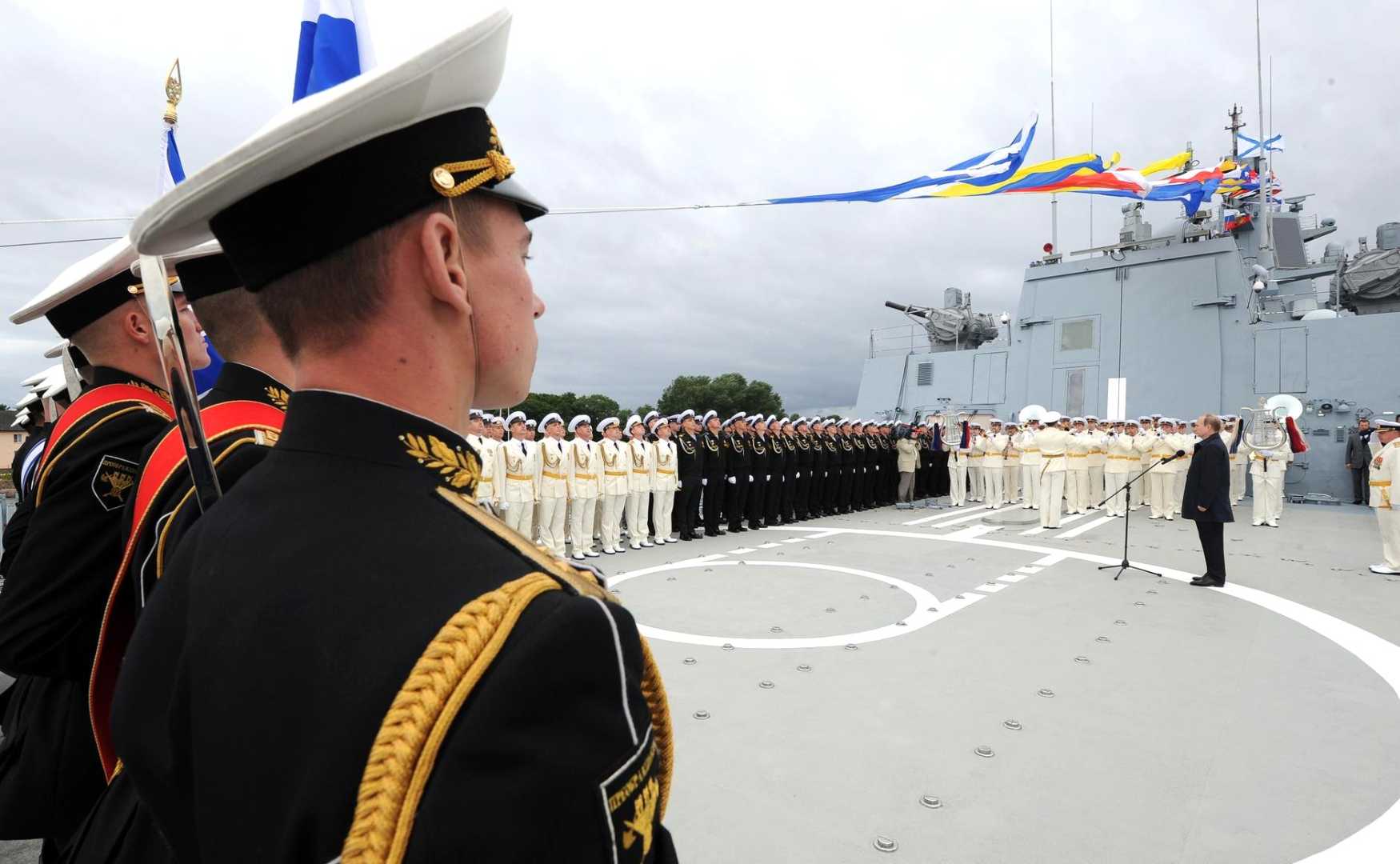
Putin used the occasion of the Navy day to announce the revisions in the Maritime Doctrine and the expansion of naval activities in the Arctic is indeed very visible. A couple of days prior to this announcement, Admiral Vladimir Korolev,the Commander of the Navy, had informed that the tree Borei-class submarines (Yuri Dolgoruky, Aleksandr Nevsky, and Vladimir Monomakh) would go this year into the Arctic for . It is unclear, whether this means that the of Aleksandr Nevsky to the Pacific Fleet in September this year is cancelled.
Setting new ambitious maritime goals may sound very grand and make international headlines, but in fact, the Russian Navy 鈥� and is set to be a big loser in the unavoidable deep cuts in the 2020 Armament program. Rogozin was forced to admit earlier this month that was severely affected by the interruption of cooperative ties and had failed to proceed with import substitution. The of the major deal with France on the delivery of two Mistral-class amphibious assault ships for the Russian navy was a big blow to the plans for expanding naval power projection capabilities. Symbolically, at the naval parade in Baltiisk which Putin attended, a missile from a ship, and at the Black Sea Fleet parade in Sevastopol, a immediately after launch.
These embarrassing technical failures remind that the Bulava missile for the Borei-class submarines is now mass-produced without completing the whole program of tests, and the of these tests is far from stellar. The risks involved in demonstrating Russia鈥檚 naval might may be acceptable by Russian standards 鈥� but they are seriously worrisome for the European states who happen to be its neighbors.
Related comments