Putin talks the Arctic talk and fingers the missile stick
Posted Tuesday, 16 Apr 2019 by Pavel K. Baev
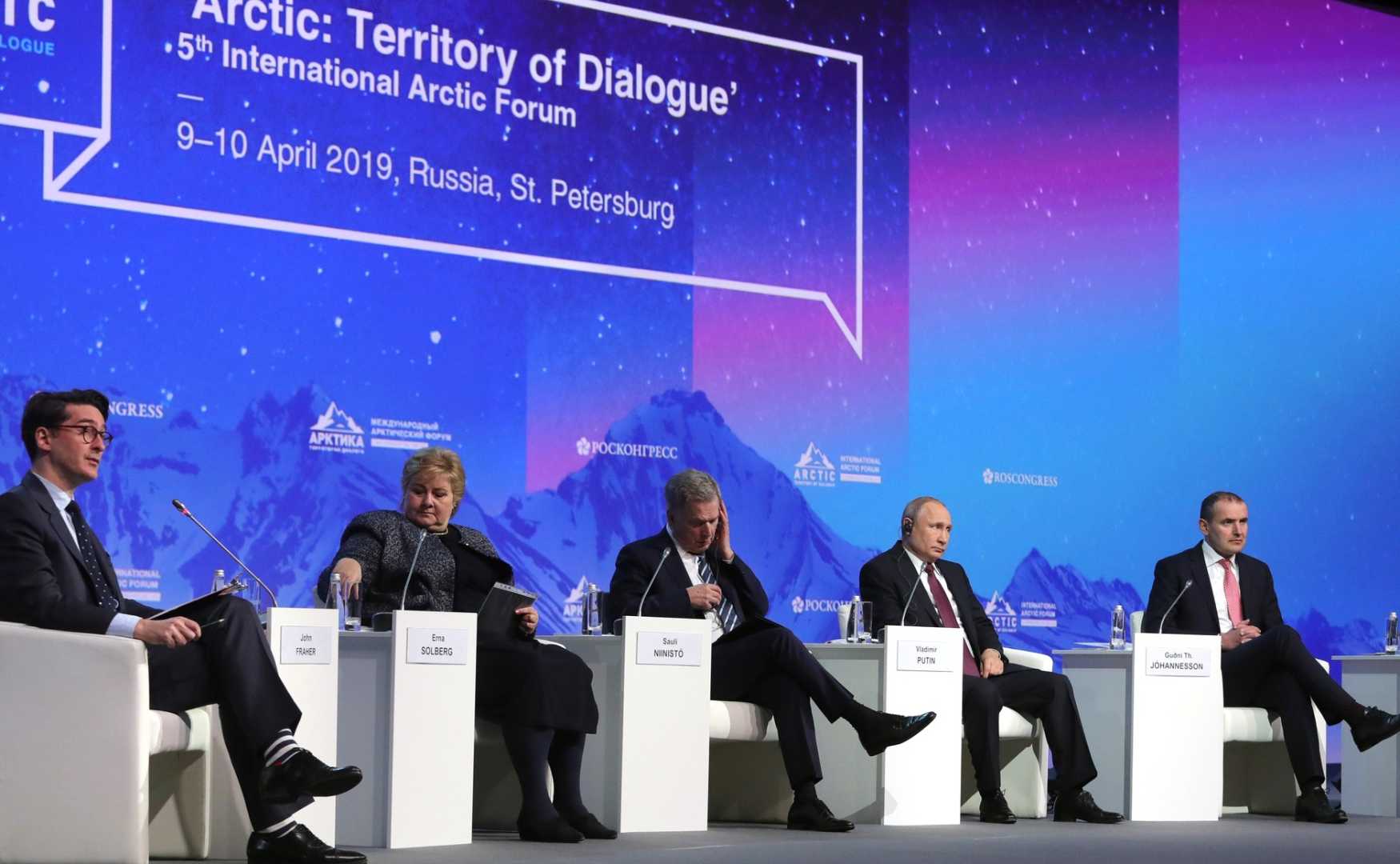
The fifth Russia-sponsored international forum 鈥淭he Arctic 鈥� Territory of Dialogue鈥� was staged last week in St. Petersburg, and President Vladimir Putin used the occasion to demonstrate his particular interest to the Arctic matters. He was joined on the panel by prime ministers of four North European states 鈥� Finland, Iceland, Norway, and Sweden 鈥� who that the tensions in the High North would remain manageable. Putin has few concerns about such global issues as the melting of Arctic ice or the pollution caused by the black sooth, which is prioritized by Finland in its rotating chairmanship in the Arctic Council. What Putin is really interested in is using the forthcoming in 2021-2022 Russian leadership in this institution for reinforcing Russia鈥檚 coveted status as the 鈥淕reat Arctic Power鈥�.
Economic cooperation could have been the most natural topic for discussions at the forum, but prospective ties are effectively curtailed by the sanctions, which target specifically joint projects in the Arctic. The plain point made by Finnish prime minister that sanctions would remain in place as long as Russia鈥檚 aggression against Ukraine continues irked Putin, who declared that Crimea had nothing to do with the Arctic and that Europe suffered from sanction as Russia did. The accuracy of such wishful calculations cannot be verified and certainly wasn鈥檛 increased with Putin鈥檚 estimate of Russia鈥檚 investment in import substitution, which left Minister of Economic Development Maxim Oreshkin . Putin followed-up by denying the spectacular growth of shale oil and gas production in the US and claimed that in some states where these resources were developed, households got from tap.
Such ridiculous assertions invite questions about the sources of information available for the Russian leader, who tries to convince foreign customers that the Northern Sea Route is open for commercial transit. Maritime traffic along this hard-to-navigate waterway has indeed significantly increased as Novatek started shipping LNG from the Yamal peninsular, . Western investors, however, remain wary about exposure to political pressure and corruption in Russian energy business, profitable as it may be, and Shell opted last week to with Gazprom. As for the transit traffic in the Northern seas, it is not boosted by new rules and regulations introduced by Moscow every year. The chain of from Chukotka to the Frans-Josef Land is supposed to ensure capacity to enforce these rules, even if China is not exactly thrilled about this militarization of the Arctic. What worries Russian top brass the most is the expressed intention of the US Navy to exercise combat ships in the Northern seas in order to re-establish the norm of the .
Demonstrating readiness to counter this challenge is a task of greater priority than cultivating cooperation with the Arctic neighbors. Indeed, as Putin was trying to lure Western investors with new in the Arctic, the Northern Fleet was conducting exercises off the coast of Norway. The from the nuclear cruiser Petr Veliky and were much larger in scale than those aimed at disrupting NATO鈥檚 Trident Juncture exercises last autumn. Mainstream Russian media is usually keen to advertise Russia鈥檚 military might; last week, however, it didn鈥檛 publish a word or utter a sound-bite about the Northern Fleet exercises.
One important addition to the combat order of the Northern Fleet last year was the , so that this summer its landing ships will be able to visit the distant bases without requesting support from the civilian icebreaker fleet. Russia鈥檚 main strength in the northern seas is, however, the nuclear submarines, and this year several new ships are due to be commissioned, including the fourth Borei-class strategic submarine . Putin has boasted about the newly-designed nuclear-propelled unmanned underwater vehicle Poseidon, which will be carried by the , due to be launched this year after 17 years of construction. Another of his pet-projects is the hyper-sonic anti-ship missile Zircon, which was successfully tested from land-based launchers and this year is from the new Yasen-class Kazan nuclear submarine.
This massive submarine-building program demands sustained priority funding, and one inevitable consequence is curtailing of budget allocations for social programs, which is particularly painful in the impoverished regions of the High North. The accumulating discontent manifests itself in unexpected outbursts, like the against the dumping of garbage from the Moscow region. Corruption in the military-industrial complex may be a top state secret, but it contributes directly to the , so that the upper 3 per cent of Russia鈥檚 population control 89 per cent of all financial assets. The Arctic still occupies a special place in Russia鈥檚 national identity, but the proposition for asserting Russia鈥檚 sovereignty over the Arctic seas by building up the military might doesn鈥檛 command public support, and of Russians are now prepared to vote again for Putin, the lowest indicator for many years.
New submarines and missiles probably produce a feel-good geopolitical perspective for the Kremlin, but this military position of power doesn鈥檛 pay any political dividends because the Nordic neighbors refuse to be intimidated. This build-up doesn鈥檛 make much strategic sense either, because Russia鈥檚 security is not threatened from the High North, while it is quite vulnerable to threats in other theaters, particularly the Far East. Putin鈥檚 two-track Arctic policy has become self-defeating as resolute militarization undercuts prospects for developing international cooperation 鈥� but yields diminishing returns in terms of capacity for projecting power. He may still cherish some feelings about the Arctic, but he hasn鈥檛 travel anywhere near it for the last couple of years and hardly has a clue about the deterioration of living conditions for the majority of local population. Brandishing wonder-missiles is a poor substitute for sober downsizing of unsustainable ambitions.
A version of this article is published in .
Related comments