Closed Borders, but Continued Migration?
Posted Friday, 19 Mar 2021 by Marta Bivand Erdal
Passing a year on from the massive closure of borders globally in March 2020 offers an opportunity to reflect on migration, borders and the pandemic. What has been the impact of closed borders on international migration? And what do some impacts look like: seasonal work, remittances, risk and recognition?
Taking a step back, what has actually been happening? According to the International Migration Outlook ‘Migration flows to OECD countries – measured by new permits issued – are estimated to have fallen by 46 per cent in the first half of 2020, and 2020 is expected to be a historical low for migration to OECD countries’.
At the same time: ‘Between 11 March 2020 and 22 February 2021, . At the same time, 189 countries issued 795 exceptions to these restrictions, thus enabling mobility’. This is documented by the IOM in their COVID-19 Travel Restrictions monitoring, .
Border closures and mobility restrictions, however, are not only , but a global issue. The impact on migration, internal, regional and international, is a global phenomenon. We might consider three specific areas of impact: seasonal work; remittances; risk and recognition.
Seasonal Work
Much attention has been focused on , in the context of the pandemic. In the agricultural sector there has been a long history of seasonal migration – not just in European countries. It is also a matter of food security at different scales, whether for farmers, migrant workers, societally and economically, especially in poorer areas of the world. Despite this, seasonal work in the agricultural sector is to , which means that needs, planning, and Covid-19 impacts are hard to assess properly. It is undercounted for several reasons, among which are the different categories and permit types under which migrant workers are registered in different countries, and where they actually work, initially or over time.
Furthermore, considering seasonal work in the context of the pandemic, it has become very evident how migrants . This also extends beyond temporary, seasonal migrants of course, and raises questions about how we approach what is often referred to as low-skilled labour. The salience of migrants’ contributions in the health sector, in services, and in construction is a reminder of often critical reliance on migration. During the pandemic it has become more and more clear that in many instances not only seasonal workers, but migrants and in societies around the world.
seasonal work in the agricultural sector is to , which means that needs, planning, and Covid-19 impacts are hard to assess properly.
Remittances
The money migrants send back, remittances, are a critical source of funding securing many families lives, but also in macro-economic terms for nation-states. In March-April 2020 concerns over remittances levels falling in 2020 in the face of the pandemic were huge. for 2020 show a significant dip in remittances received, starting in March 2020 and continuing into April and May, but then remittance levels pick up through the summer. Comparing with autumn 2019, we see that autumn 2020 levels are above the preceding year. This seems to suggest remittances in the context of this pandemic are an incredibly resilient source of finance for families and societies, . Data for 2020 published in January 2021 to Latin America and the Caribbean during 2020 (compared with the preceding year), and confirm the resilience of remittances during the pandemic.
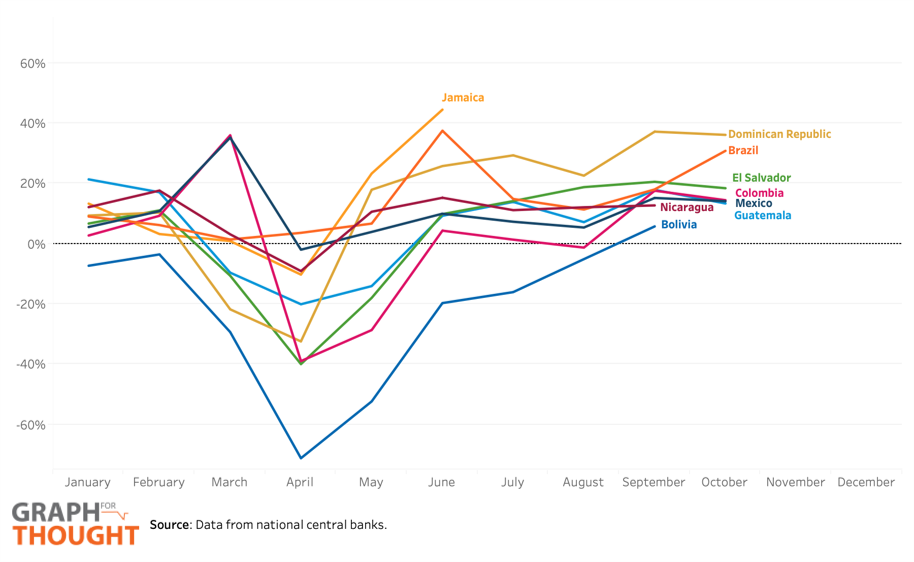
, and two reasons are suggested as to why remittance levels may have decreased less in 2020 than expected based on the repatriation of workers from the Middle East, other return of labour migrants and unemployment among those remaining abroad: first, that more remittances may have been sent from permanent migrants in more stable work situations abroad compensating for reductions elsewhere; second, that due to mobility restrictions, money which otherwise might have been brought home in cash and remained unregistered, in 2020 was transferred through formal transfer mechanisms, and thus counted.
It is too early to assess the pandemic’s impact on international remittances fully, yet there is obviously huge variation between different remittance corridors and individual experiences, , but the decline in remittances forecasted due to the pandemic than the World Bank first anticipated.
Risk and Recognition
So the pandemic has shown that migrants are essential workers. Yet, the risk which many migrants face as front-line workers, in jobs which often are tough, has only slowly been recognized, and not always effectively acted upon. There is also the risk, of course, that migrants travelling for work expose not only themselves but also others too. That said, questions might be asked about whether authorities in European countries really understand the demographics of their own populations, which are also composed of migrants and their descendants, well enough. This relates to issues such as socio-economic inequalities and housing conditions, multi-generational households and linguistic competence, relevant both to preventing spread of Covid-19, but also to how vaccinations are prioritized.
The UN high commissioner for Human Rights has explicitly by the pandemic in many countries. Ultimately, questions should also be asked about longer term post-pandemic perspectives on crisis management in societies characterized by migration-related diversity. In practical terms this means , considering which channels, languages and formats might be the most effective. But also recognizing that the trust necessary for such communication to work in crisis depends on sustained building and maintenance of trust in normal times, in order to reach the whole population.
Covid-19 . First, reliance on migrants work effort is heavy, but there seems to be reflecting a recognition of this reliance. Second, the pandemic in general, but also border closures and mobility restrictions specifically, underscore our economic and social vulnerabilities. These are largely interconnected and thus shared vulnerabilities, which demonstrate the necessity of the approach to migration taken in the – one that is holistic. Such an approach is not always easily traceable in concrete policy measures in different countries, however. Third, there is a paradox in how what might be described as an obsession over ‘immigration’ appears in parallel with a basic insight that the roles of migration and migrants are often fundamental to how our societies function. This disconnect is paradoxical, and illustrates how concerns that dominate public debate may be quite disconnected from the reality on the ground, and deflect policy attention from real problems which require concrete solutions.
- This blog post is based on an intervention during the session: The COVID-19 lockdown one year later: Pandemics and borders, during the Winter Seminar in Human Geography – 12 March 2021.
Related comments