Are Women the Solution to Violent Extremism?
Posted Wednesday, 9 Jun 2021 by Jenny Lorentzen
Women can contribute to preventing and countering violent extremism, but the international community鈥檚 understanding of their contributions is lacking.
Women are often expected to assume roles as deradicalizing councillors or informants, but depending on context, it may be unsafe and unrealistic to assume that women will take on such roles. If policies designed to combat violent extremism are to be effective, they must be based on the realities of women鈥檚 experiences with violent extremism rather than on gender stereotypes.
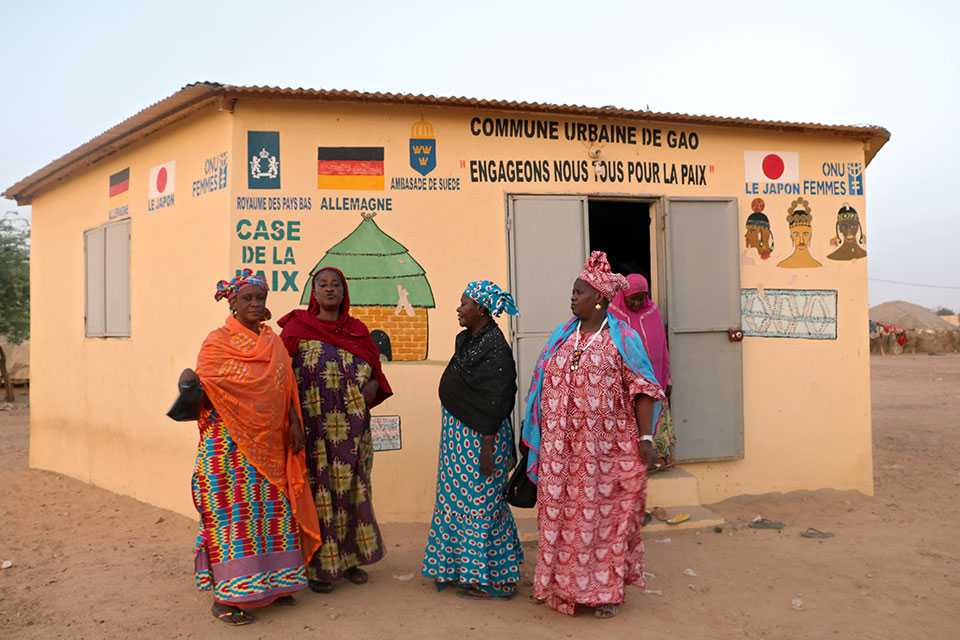
Since 2000, women鈥檚 contributions to conflict prevention and resolution are a key aspect of the UN鈥檚 Women, Peace and Security (WPS) agenda.
In recent years, a global policy agenda on preventing and countering violent extremism (P/CVE) has developed in response to the rise in the number and scope of extremist movements such as ISIS, Boko Haram, the Taliban and al-Shabab. Today, these global policy agendas are promoted in countries understood to be at risk of experiencing violent extremism and in those countries already experiencing it.
In , I investigate the implementation of the global policy agendas on WPS and P/CVE in Mali. I show how through this process, gender stereotypes are reinforced, and women are assigned roles as security actors. I illustrate how there are discrepancies between the stereotypical ideas about women鈥檚 roles and the great variation in Malian women鈥檚 experiences, contexts, and identities.
Women as 鈥榥ew security actors鈥�
I found that UN policy agendas on WPS and P/CVE in Mali construct roles for women as 鈥榥ew security actors鈥� who contribute to preventing violent extremism by influencing, counselling and/or informing on their family or community members.
In fulfilling these roles, women are expected to use their positionality as mothers, wives, sisters, or daughters to obtain information about those who are being radicalized and to inform the authorities. Additionally, women are also expected to intervene themselves by counselling their husbands, brothers, or children towards deradicalization and detachment from extremist groups.
Among the key characteristics of women as 鈥榥ew security actors鈥� then, is their access to contexts that are out of reach for 鈥榯raditional鈥� security actors. Both in time, because they operate to prevent violent extremism, and in space, because they operate mainly in the private sphere, and through personal relationships. The rationales for including women thus build on the idea that women can intervene where traditional security actors cannot, and this is what is needed to achieve peace.
Why is this problematic?
It is important to note, that the 鈥榥ew security actors鈥� framing is not always problematic. Many women鈥檚 organizations advocate a role for women along these lines, and this is one way of highlighting the important work that women do in many contexts.
However, in other contexts it may be unsafe for women to act as 鈥榥ew security actors鈥�. For example, . This has left many people in these areas distrusting of the state. In these contexts, women may be at risk if they are perceived as informers for the state by their communities.
In other cases, it can be unrealistic to expect women to act as 鈥榥ew security actors鈥�. For example, it is unrealistic to expect women to tell state authorities about their children being radicalized if they do not trust in those authorities. Further, while Malian , women belonging to other population groups may hold different positions vis 脿 vis their husbands. In these contexts, women鈥檚 scope for influence and counselling is offset by their need to maintain their husbands鈥� trust and good will.
Finally, women may support extremist groups (or groups designated as extremist) and may therefore be likely to council their husbands into joining these groups.
Implications for policy
Rather than empowering women and transforming gender relations, the 鈥榥ew security actors鈥� discourse reinforces gender stereotypes and can put women at risk when their gendered roles are seen as equipping them to assist in the fight against violent extremism.
Policy makers should be aware that roles as 鈥榥ew security actors鈥� are potentially unsafe or unrealistic for women, depending on their identity and context. If interventions to prevent and counter violent extremism are to be effective, their design needs to be better informed by the realities of women鈥檚 situations and experiences.
For this, we need a better understanding of women鈥檚 everyday experiences with violent extremism, both as preventive peace and security actors, and as participants or sympathisers.
- Jenny Lorentzen is a Postdoctoral Fellow at the Department of Political Science, Lund University, and a Senior researcher at the Peace Research Institute Oslo (糖心网页版).
- Her article, 鈥榃omen as 鈥渘ew security actors鈥� in preventing and countering violent extremism in Mali鈥� was published in the May 2021 issue of International Affairs. Read the article .
- This text was first published by the 27 May 2021.
Related comments