Ceasefire as a Fig Leaf for Carnage and Confusion
Posted Thursday, 25 Feb 2016 by Pavel K. Baev
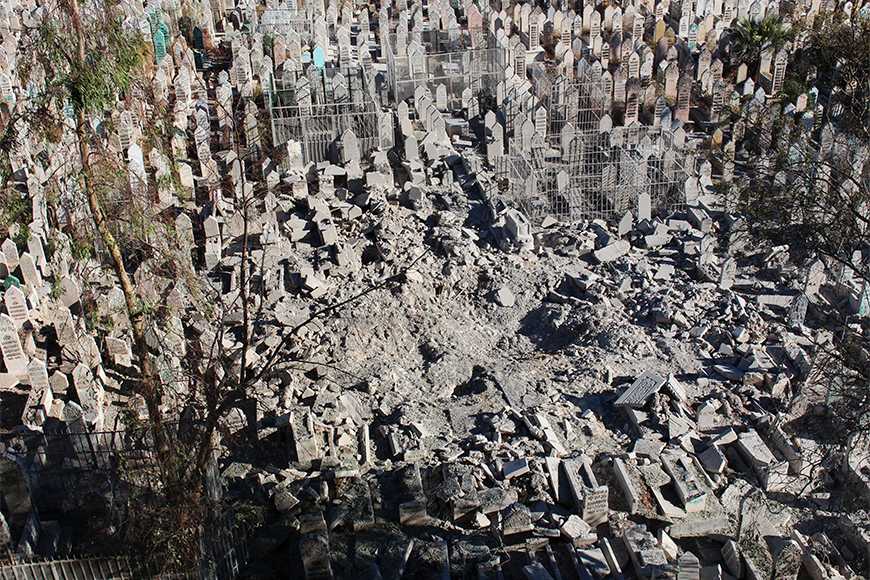
Just a couple of weeks ago, Aleppo was seen as a crucial battlefield in the Syrian civil war and was compared with Sarajevo as a tragedy of intolerable proportions not only by but also by such responsible politicians as , UK Defence Secretary. Yet presently, this devastated city is portrayed as the main beneficiary of the negotiated by US State Secretary John Kerry and Russian Foreign Minister Sergei Lavrov, and by President Vladimir Putin. The proposals for and for punishing Russia with appear to be overtaken by the fortunate turn of events. In fact, however, this idea may turn out to be too soft 鈥� and at the same time quite irrelevant for the the Syrian catastrophe. It certainly takes two for this awkward tango, but the partners have very different plans for further pirouettes.
Putin鈥檚 triumph is ephemeral
Negotiations on the ceasefire have certainly marked a big success in Putin鈥檚 high-stakes political gamble in Syria, and he proudly with his another triumph 鈥� the September 2013 agreement on eliminating the Syrian chemical weapons. The intervention was launched as a follow-up to his at the UN General Assembly on September 23, but five months into the bombing campaign, its rationale has become shaky and the Russians are .
The goal of saving the dictator-in-distress has always been of secondary importance to Putin, who has no personal chemistry with Bashar al-Assad. What mattered was to establish for fact that Russia was able to project effectively military power far beyond its borders and was, therefore, an 鈥� in the Middle Eastern turmoil. The only proof positive for gaining such a role was in direct negotiations with USA, and now the telephone conversations with Obama, who had to swallow his against Russian armed intrigues in Syria, have delivered just that.
One remarkable feature in the ceasefire deal is that Russia doesn鈥檛 have to do anything to implement it because its official justification for airstrikes has always been targeting the ISIS (Daesh) and other terrorist groups, so it can continue doing just that. The fact that all opposition to the al-Assad regime is defined as 鈥渢errorists鈥� is beyond the point, as Moscow takes the of not distinguishing between good and bad terrorists. What matters, however, is that Russian intervention is a high-risk enterprise and a disaster in the form of a technical failure (all in the Russian Air Force) or an ambush on a convoy travelling from Tartus to Latakia is waiting to happen. Russia is also involved in a bitter and dangerous confrontation with Turkey, which is far about the ceasefire deal, and seeks to prevent a Turkish intervention into the Syrian war .
One advantage in Putin鈥檚 position is that he sincerely doesn鈥檛 care about the humanitarian costs of the Syrian catastrophe or civilian casualties in the airstrikes. The refugee problem is of importance for him only insofar as it generates pressure on Turkey and the EU. If this ceasefire deal collapses, he is ready to negotiate another one generally aiming at creating a situation similar to the Minsk process in Ukraine, which as all parties to it know perfectly well, doesn鈥檛 and cannot work; yet they all agree that .
US confusion is not predetermined
What makes it possible for Putin to succeed in the diplomatic maneuvering despite the precarious trajectory of the Russian intervention, is the profound and seemingly inescapable confusion in the US Syria/Iraq policy. The hard core of this policy is the military campaign against ISIS, which may yet see a but has achieved little so far. This campaign is completely detached from the of removing from power the al-Assad regime, and quite possibly it is the weight of the historic blunder of invading Iraq in 2003 that prevents Washington from acting on this goal. The attempts to convince various factions of Syrian opposition to prioritize the fight with ISIS have brought mixed results, and more recently 鈥� as rebel groups armed by the CIA engaged in fighting against Kurdish forces supplied by the Pentagon.
The lack of confidence in US leadership prompts the regional powers to build alliances of convenience for securing there interests. Turkey, for that matter, feels that it doesn鈥檛 get enough in its confrontation with Russia, and at the same time builds military ties with Saudi Arabia on the basis of common understanding of the need . Israel but also cannot ignore the fact that Hezbollah has to all intents and purposes become a military ally to Russia. Moscow is keen to and its aim in the talks with Washington is to add to this sum and to lull every regional power (with the obvious exception of Iran) into inaction.
The deal with Russia, therefore, provides no escape from this confusion and it may indeed, as John McCain warned strengthen the impression that USA are 鈥溾��. The problem is not that the ceasefire of the last resort will fail, but that it signifies a political victory for the al-Assad regime, which remains the fundamental cause of the Syrian civil war. The only way out of the protracted confusion for the US is to get serious about building an anti-Assad coalition in parallel with adding strength to the anti-ISIS coalition and achieving synergy from this combination.
New sanctions on Russia would not help much in this undertaking. There is always a point in fine-tuning the sanction regime and targeting better the Russian export of corruption, which is a far more useful instrument for its policy than the oil-and-gas export. The main emphasis, however, has to be placed on proving the failure of the Russian desire to harvest rich political dividends from a limited and stretched projection of its fast-declining power.
Related comments


Posted by
All tags
