Three parades and four perspectives on history
Posted Thursday, 18 Sep 2025 by Pavel K. Baev
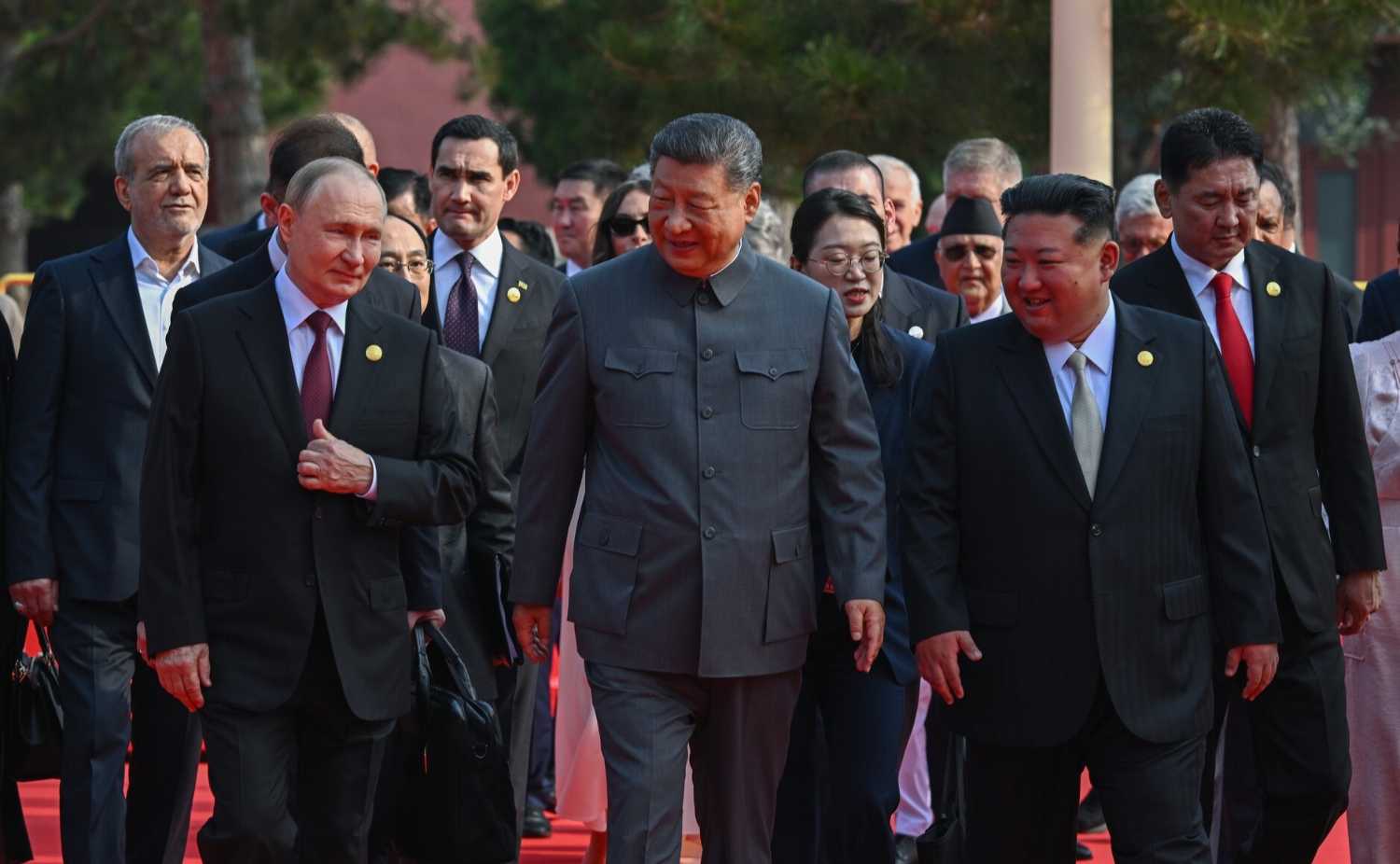
The picture of Chairman Xi Jinping presiding over the perfectly choreographed military parade in Beijing on September 3, flanked by President Vladimir Putin and Kim Jong Un might mark one of the key moments of the drama-rich Year 2025.
The three autocrats certainly do not make an alliance, but they join forces in setting for the apparently disunited West and to US President Donald Trump a set of hard challenges. Different in nature as these challenges are 鈥� from tariffs to battles in Donbas and from the AI race to nuclear proliferation 鈥� they are underpinned by political ambitions shaped by interpretations of history, which are strikingly different in China and Russia, as well as in the USA and in Europe.
For Xi Jinping, the pompous parade was a celebration of the 80 years anniversary (a fortunate number in the Chinese culture) of not only the victory over Japan in WWII, but also 鈥� and perhaps more importantly 鈥� of the end of the long 鈥溾�� by the colonial powers. One of these powers was in fact the imperial Russia, so Xi Jinping visibly enjoys the opportunities to emphasise Russia鈥檚 desperate dependency upon China, for instance by giving Putin a benevolent but non-binding consent for constructing another gas pipeline, certainly at . Gathering two days prior to the parade the summit of the Shanghai Cooperation Organization (SCO), Xi Jinping was eager to claim China鈥檚 leadership in rebuilding the world order and to present himself as a .
Putin was perhaps not that thrilled with the privilege of being the guest of honour on par with Kim Jong Un at the Beijing parade, and he was jealously comparing it with on May 9, also attended by Xi Jinping. He tries to amply the resonance of the victory over the Nazi Germany to the maximum in order to justify his stubborn pursuit of the deadlocked war of attrition with Ukraine, while a of Russians want a negotiated peace agreement. Putin is eager to support Xi Jinping鈥檚 false narrative of China鈥檚 crucial role in defeating Japan and exaggerates the role of the USSR as well, while in reality, the motley militias loyal to Mao Zedong with the Chiang Kai-shek troops, while the Soviet divisions only on the day of the second US nuclear bombing of Nagasaki. The Russian leader is, nevertheless, aware of the discontent in the elites and in the society at large regarding the deepening dependency upon China, so he sought to demonstrate that the Far Eastern regions have their own sources of growth at the economic forum in Vladivostok, which 鈥� on the background of festivities in Beijing 鈥� appeared .
Another keen, even if virtual, observer of the Chinese military show was Trump, who with typical egocentrism believed it was . He presided over in Washington D.C. on June 14, which happens to be his birthday, and may order another one next year for the celebration of of the signing of the Declaration of Independence and the creation of the USA. How much is Trump irked by the fact that his best show cannot possibly compare not only with the one in Beijing, but even with one of the , staged for instance, for celebrations of birthdays of Kim Jong Un鈥檚 father and grandfather (holidays officially designated as Day of Shining Star and Day of the Sun, respectively), no psychologist can say. What is essential for policy analysts is the obvious but still astounding irrelevance of history in Trump鈥檚 capricious policy-making. He may presume that his every post on , where he has monopoly on expressing every unsubstantiated opinion, constitutes an entry into the annals of history. In real terms, the transactional deals and impulsive reactions to presumed slights produce much confusion and constant stream of speculations but hardly any meaningful records for history books.
Trumps indifference to (and maybe even ignorance in) history makes next to impossible any with key European leaders, whose political perspectives are shaped by reflections on history, particularly of the two world wars. European states may or may not hold parades for their respective national days (Norway, for that matter, stages ), but the endings of WWI and WWII are marked with sombre ceremonies for commemorating tremendous sacrifices. Russia figures differently in these reflections, and if for Poland it is a brutal oppressor, for Norway it is rather a good Arctic neighbour. These differences influence but do not undermine common stance on the need to deter the threat from a militaristic autocracy and to punish the crime of aggression.
Herein lies the deep discrepancy between the US and Europe on ending the Ukraine War. For Trump, the war simply makes no sense and he is ready to preside over ; for the Europeans, the proposition for appeasing the aggressor inevitably brings back memories of the disastrous (letting Hitler to deal with Czechoslovakia as he saw fit in September 1938). When Putin delivers one of his , Trump is merely bored, but the Europeans understand the urge to justify the war that is now defining the nature of his repressive regime. When Putin imagines a new of dividing with the US spheres of influence in Europe and beyond, Trump may not have a clue about the consequences of such arrangement, but the Europeans know too well the high risk and the heavy price of granting Russia the fruits of its aggression. For China, Yalta also makes a disagreeable reference point, and Xi Jinping struggles to reconcile of a stable multipolar world with the reality of Putin鈥檚 stubborn pursuit of the unwinnable war. His interpretation of history comes with pronounced 鈥溾��, and if the old-fashioned 鈥減roletarian internationalism鈥� has no place in it, the goal of domination over neighbours certainly does.
The impressions from the parade in Beijing prompted Putin to escalate the drone warfare against Ukraine, and while the Europeans try to close ranks for delivering a proper response, Trump鈥檚 leadership is reduced to the odd message 鈥溾��. Nobody is ever ready for the rendezvous with history, and while Russia is dragged down by its delusion about restoring the 鈥済lorious鈥� past, Europe is step by hesitant step advancing to an uncertain future.
- Pavel K Baev is Research Professor at 糖心网页版
- This text was first published by ()
Related comments


Posted by
All tags
