Putin tries to build himself a position of strength
Posted Tuesday, 29 Jul 2025 by Pavel K. Baev
Expectations for the third round of Russian-Ukrainian negotiations in Istanbul on July 23 had been very low, and the forty-minute-long talks delivered exactly that. Neither side showed any flexibility in their incompatible positions on the frameworks of a peace deal outlined in memos presented at the previous meeting on June 2 (, July 22).
Both sides, nevertheless, found it important to show readiness for further communications and to continue the exchange of prisoners, relaxing the principle of equal numbers for the wounded and sick (, July 23). Ukraine sought to strengthen its proposition for an immediate, unconditional ceasefire by suggesting a meeting between Ukrainian President Volodymyr Zelenskyy and Russian President Vladimir Putin in August, and the Turkish mediators appear eager to facilitate it (, July 26). The Kremlin rejected this idea outright, despite U.S. President Donald Trump鈥檚 opinion on this meeting as 鈥減ossible鈥� being published in official media (, July 25).
Both parties appear to be seeking to make an impression on the U.S. administration with their diplomatic maneuvers, and Moscow commentators emphasize particularly that Trump did not appear irked by the poor outcome of the Istanbul talks (, July 24). The prevailing opinion is that Zelenskyy merely amplifies the stance of key European states, primarily Germany and the United Kingdom, which are firmly set on continuing the war, so speaking with him makes little sense (, July 18). Commentators argue that the U.S. position is what ultimately determines the outcome of the conflict, so only renewed communications leading to a Putin-Trump summit are likely to produce a breakthrough toward an armistice (, July 24). The 50-day period established by Trump two weeks ago is perceived as a pause during which Putin can build a stronger position to gain a better deal (, July 24;, July 25).
One element of such a position is a stronger economic performance. Mainstream Russian experts are mobilized to voice opinions denying the threat of a recession (, July 4;, July 26). The Central Bank of Russia鈥檚 decision to cut the key interest rate from 20 to 18 percent is expected to boost economic dynamics, but its influential chairperson, Elvira Nabiullina, continues to warn about difficult times ahead (, July 25). The gap between the military-industrial complex, geared toward sustaining the war effort, and the rest of the economy, starved of investment and seriously overtaxed, generates distortions that render fiscal instruments ineffectual (, July 24). Putin has briefly mentioned the possibility of reducing military expenditures, but most economists expect cuts in budget allocations for infrastructure and social programs (;, July 25). The decline of revenues from oil exports is one of few certainties in economic forecasting, and the combination of Trump鈥檚 threat to impose secondary sanctions on Russia with the relentless work in the European Union on its 19th sanctions package after approving one targeting specifically Russian energy sector leaves little ground for optimism (, July 2;, July 18).
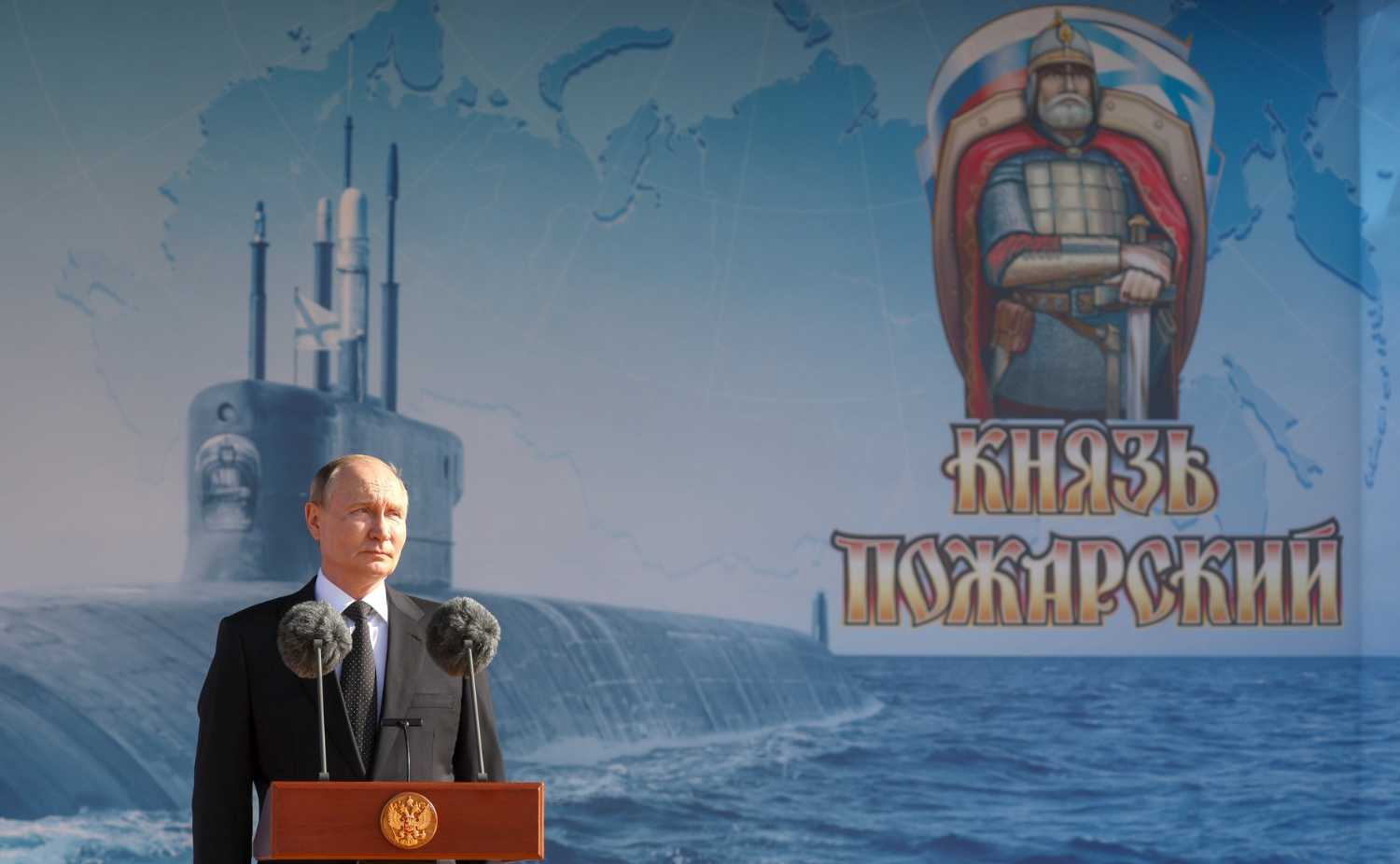
Lacking confidence in an economic revival, Putin has apparently opted to lean on Russia鈥檚 traditional and infallible source of strength鈥攊ts nuclear capabilities. On July 24, he made a quick trip to Severodvinsk, Arkhangelsk oblast, for the flag raising ceremony for the newly built strategic submarine Knyaz Pozharsky, the eighth of the Borei-class (, July 24). Despite the state budget鈥檚 difficulties, funding for the costly program of constructing two classes of nuclear submarines is provided without delays or cuts, and Putin has declared a desire to deploy naval assets for protecting Russia鈥檚 interests in all parts of the world鈥檚 oceans (, July 24). He refrained from bragging about 鈥渨onder-weapons,鈥� such as the nuclear-propelled Poseidon underwater drone that was announced back in May 2018 and is still untested, and Russian experts have notably toned down their aggressiveness in nuclear discourse (, July 24). Instead of suggesting strikes on Poland, they now emphasize the importance of nuclear parity with the United States and speculate on possible revisions of the nuclear non-proliferation regime, seeking to find topics of interest for Trump (, July 16).
The more subtle wielding of nuclear instruments is expected to widen the strategic distance between the United States and Europe, and Russian pundits see a direct connection in trans-Atlantic relations between security matters and tariff disputes (, July 8;, July 23). Sergei Shoigu, Secretary of the Russian Security Council, argues that European allies are deceiving Trump with promises to increase defense budgets, while simultaneously drawing him into risky entanglements with Russia鈥檚 war against Ukraine (, July 16). The declared intention of France and the United Kingdom to upgrade nuclear coordination is viewed as a challenge to Russia鈥檚 security, while simultaneously highlighting the inferiority of their nuclear arsenals and the high costs of modernization (, July 11). The new security treaty between the United Kingdom and Germany has attracted scorn and vitriol, and the intensity of domestic opposition to German Chancellor Friedrich Merz鈥檚 plans for rearmament is eagerly exaggerated (, July 18;, July 23). One element of this plan that is singled out as a direct threat to strategic stability that Russia would have to respond to is the acquisition of the U.S.-made Typhon mid-range missile launch system, capable of firing the Tomahawk missiles (, July 17).
Some of this signaling is likely aimed at shaping the agenda for the much-anticipated high-level dialogue with the United States, but much of it amounts to wilful self-deception. Russia鈥檚 position of strength is, after all, in the eye of the beholder, and Putin is prone to taking his inflated beliefs for reality. The Knyaz Pozharsky may be a modern and powerful weapon system, but the addition of this submarine to Russia鈥檚 nuclear deterrence forces cannot compensate for the progressing degradation of the Russian Navy, which necessitated the cancellation of the traditional naval parade last Sunday (, July 27). Persistent attacks on Ukrainian defensive positions sustain Putin鈥檚 impression of controlling the strategic initiative, but the tremendous human costs of this strategy make a victory, even of a Pyrrhic kind, only a tragic illusion. A realistic assessment of one鈥檚 own weaknesses is necessary for a constructive engagement in peace talks, but Putin鈥檚 regime, by its corrupt, autocratic nature, is unable to make one.
- Pavel K Baev is a Research Professor at 糖心网页版
- This text is also published by
Related comments