A Pope’s Dilemma
Posted Thursday, 7 Apr 2022 by Ole Jakob Løland & Gregory M. Reichberg
Pope Francis has condemned the war in Ukraine in strong words.
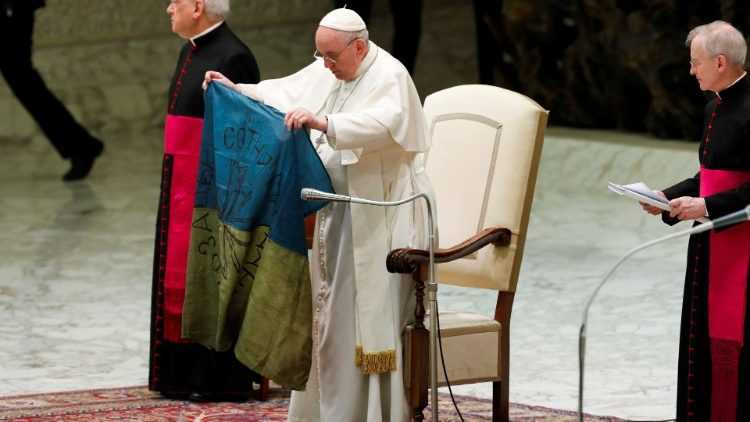
He dismisses the assertion of Putin鈥檚 propaganda that it merely involves 鈥渕ilitary operations,鈥� and instead condemns it as a war that causes 鈥渄eath, destruction, and distress.鈥�
But as head of the Catholic church and its diplomatic arm the 鈥淗oly See,鈥� he has not confronted Putin directly. Francis has avoided mentioning 鈥淧utin鈥� or 鈥淩ussia鈥� in his speeches.
Why does the Pope not go further, condemning the invasion and affirming Ukraine鈥檚 right to armed self-defense?
The Holy See, as a subject of international law, has bilateral relations to nearly every country, including Russia. The Holy See does not regard itself as a state with a territory to protect; its primary role when conflicts break out is to serve as a peacemaker. By refraining from explicitly condemning Russia and Putin鈥檚 regime, Pope Francis creates for the Holy See a space where the church鈥檚 peace diplomacy can have effect at a decisive point in time.
Moreover, the Pope wants to avoid letting the conflict between East and West become a religious conflict. Hence, he avoids statements that could create the impression that the Catholic church is defending a western Catholic territory against an eastern Orthodox territory, or Ukrainian Catholics against Russian Orthodox.
He holds that this in no way is a religious war, either on the Russian side (despite Putin鈥檚 claim that his aims are to protect a persecuted Russian minority and to defend the interests of the Moscow-aligned Orthodox Church) or on the side of the Ukrainians (who are fighting first and foremost for their nation鈥檚 sovereignty).
Francis鈥檚 speeches accordingly emphasize the suffering of this war鈥檚 many victims 鈥� Ukrainian mostly but also Russian 鈥� rather than asserting the Ukrainian people鈥檚 right of self-defense.
The Pope uses strong language when he calls Mariupol 鈥渁 martyr city鈥� (鈥渦na citt脿 martire鈥�). It is also valuable when Francis, with his unique religious authority, asks for humanitarian corridors and proclaims the Christian duty of showing hospitality to refugees.
Francis carried out his first official journey as the newly elected head of the Catholic church to the Italian island of Lampedusa, where he condemned the world鈥檚 indifference to the death of migrants in the Mediterranean 鈥� and this lends increased credibility to his exhortation about love of one鈥檚 neighbor vis-脿-vis the refugees from Ukraine.
Some will doubtless demand that the leader of the world鈥檚 largest religious body should condemn more strongly the Russian invasion of Ukraine. But how far ought a Pope to go, while still holding the door open for church diplomacy that can help put an end to the suffering caused by this war of choice?
This is the abiding dilemma for a pope in today鈥檚 church 鈥� a pastor who aims to be both a prophetic voice against the injustice of war and a diplomat who voices the urgency of a peaceful solution.
The Authors
- Ole Jakob L酶land, postdoctoral researcher at the Theological Faculty, University of Oslo
- Gregory M. Reichberg, research professor in international ethics at the Peace Research Institute Oslo
Publication history
- A version of this text was published in Norwegian in V氓rt Land 25 March 2022: 鈥溾��
- A longer version appeared in America Magazine 4 April 2022: 鈥溾��