Queer Paradoxes after the Pride Terror Attack
Posted Friday, 23 Jun 2023 by Maja Vestad
Earlier this week, my partner bought some rainbow-coloured yarn. While we queued at the till, a mother in front of us pointed at our yarn and said to her child: Look! Just like you! A small voice addressing an enormous issue.
Being queer feels different this year and I鈥檒l explain why.
Is our time of safety in the past?
Being different has never been completely safe. Coming out as queer can be polarizing. Relatives keep their distance, people find us embarassing; they want us to tone it down. So we鈥檙e cautious about who we spend time with; what people know about us; how we behave. This is because some of us , , and killed.
To some extent there was safety before, but it was never absolute.
Our worst fears were realised this time last year, when Islamist extremists planned and executed a terror attack right in the midst of the Oslo Pride festivities. Two persons were killed and 21 more injured. Zaniar Matapour is charged with murder, attempted murder and acts of terrorism. The known Islamist Arfan Bhatti and two more men are charged with complicity in murder.
For a whole year, we鈥檝e had scarcely any information about actual threats. Instead, we鈥檝e been drip-fed information relating to the attack.
- The organisational dimension: that the Police Security Service (PST) suspected an attack might happen, but took no action.
- The ideological dimension: that the attack was an expression of extreme political hate of the rights to love and to self-determination.
- We鈥檝e also learned about the attack鈥檚 social and geopolitical dimensions 鈥� that Arfan Bhatti was involved, but is not being extradited from Pakistan.
Would it have gone differently if it had been about a different political issue?
A need for uniforms
There will be no visible police presence in this year鈥檚 parade. The police have decided that police officers to wear uniforms in the parade.
Such a major symbolic change to practice the year after the terror attack feels like a betrayal. It is more important than ever that state actors adopt clear-cut positions of solidarity. Both haters and supporters of love and diversity need to see a clear-cut official position on this issue.
At the same time, feeling betrayed by the removal of uniforms is paradoxical because historically, police has been an active participant in violent persecutions of gay communities.
Uniforms have been associated with the criminalization of homosexuality. The inclusion of uniformed police officers in 鈥淓uropride鈥� or the 鈥渇ag parade鈥� as it was called in 2005, symbolised the police鈥檚 responsibility to defend core Norwegian values by protecting vulnerable populations.
At the time, the police 鈥淲e hope this may encourage more gay people to approach the police if they need help鈥�. The uniforms that at one time signalled danger later came to signal support. Now they disappear completely. Isn鈥檛 this exactly when we need them?
The distance paradox
At the same time as uniformed personnel are keeping their distance, we read about the burning of Pride flags and about children not getting to participate in children鈥檚 pride parades alongside other festive rainbow children.
The burning of Pride flags generates fear, and this fear causes children鈥檚 activities to be cancelled. In fact, the situation is so tense that the believe that people and places linked to Pride 鈥渁re in the scope of the enemy picture of both far-right extremists and extreme Islamists and have become relevant as targets over the past year鈥�.
Safety in this context means distancing oneself from other queer people, but distancing oneself because of fear is paradoxical; historically, queer communities have fought precisely for the right to co-exist.
Is it rational to hide?
Another reason that it is different to be queer this year is that the perpetrator has yet to face trial. The courts, apart from extending the perpetrator鈥檚 period of pre-trial detention, have not yet come to a conclusion on his criminal accountability.
After the terror attacks of 2011, we were able to see and read about the proceedings in Oslo District Court. The 2011 terrorist acted alone and thus it was safe to participate in 鈥渞ose parades鈥� and hold commemorative ceremonies. The government鈥檚 communication was clear.
And then, as now, a debate proceeded in parallel about the perpetrator鈥檚 sanity. We are being told that the 2022 terrorist has a psychiatric history indicative of a reduced capacity to act rationally. And that there may be other, similarly unpredictable people.
We鈥檒l be hosting a Pride breakfast at our house, but it will take place behind closed fences 鈥� I still don鈥檛 know whether it鈥檚 sensible to parade in the city centre right now. Is it rational to hide, or is it rational to be visible?
The road onwards must be protected
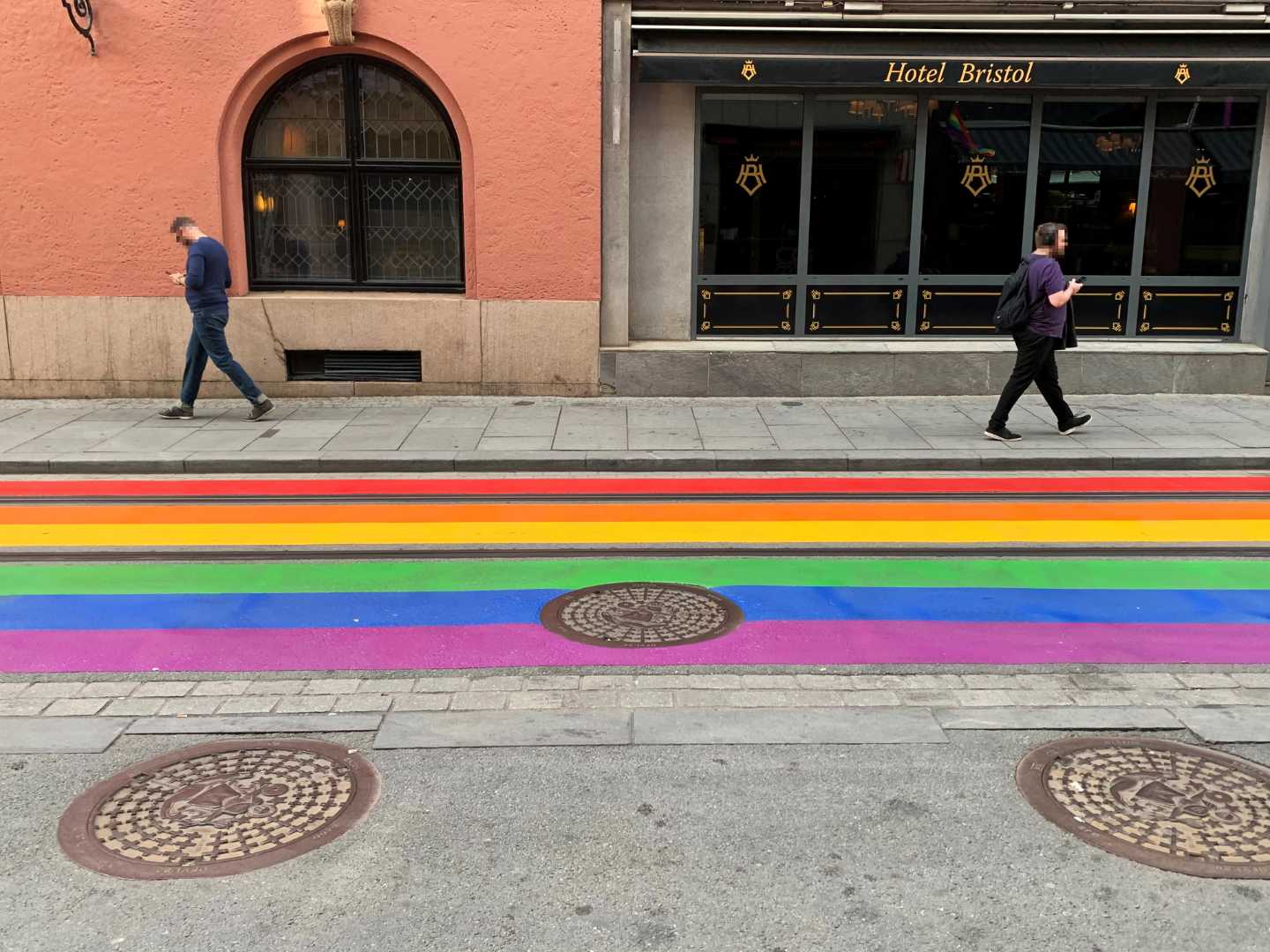
The street where the attack took place has since become a Pride street. Fifty metres of rainbow colours extend from north to south.
But it鈥檚 expensive to repaint the street each year, so the street is closed to traffic 鈥� no one is allowed to drive across the painted colours. The road must be protected. It must be safe for us to spend time in a place where our worst fears were realised. This is a symbolic policy,
Even so, this year I won鈥檛 dare to hang a rainbow flag from our ground-floor terrace: I鈥檓 afraid someone will set the flag alight; I live in a wooden house; it would be catastrophic. But our upstairs neighbours are flagging. At the kindergarten, the flag flies on a flagpole. Everywhere, rainbow colours are flying high enough to be out of the reach of a matchstick.
- is a Doctoral Research Fellow at the Department of Criminology and Sociology of Law, University of Oslo. She is part of the , partly run at 糖心网页版
- This text was published in Norwegian by
- Translation from Norwegian: Fidotext

