Turkey’s Ambitions in Africa
Posted Thursday, 5 Jun 2014 by Pinar Tank
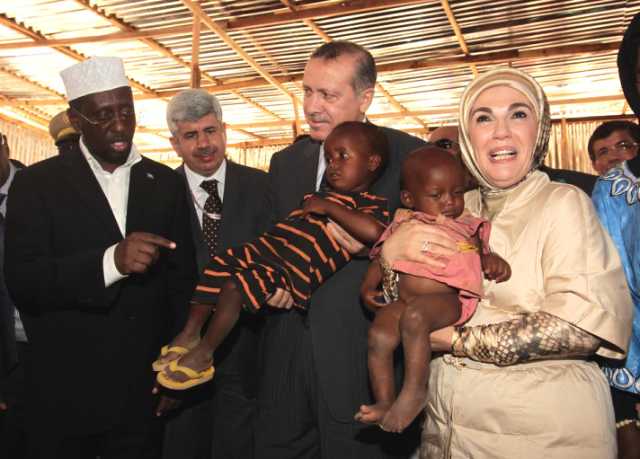
In August 2011 Turkish Prime Minister took his family, his foreign minister, and an entourage of cabinet members to visit Somalia as part of a humanitarian mission to highlight the plight of 12 million Somali victims of . The visit was symbolically important, as 贰谤诲辞臒补苍 travelled to Mogadishu, the first visit to the Somali capital by a leader from outside Africa in 20 years. Also symbolic was the timing, coming as it did during the holy month of in which Turkey alone raised 201 million USD in humanitarian relief. The magnitude of the Somali tragedy 鈥� with the UN reporting that 3.2 million people at risk 鈥� deserves significant international attention, but even so, one can wonder what is behind the Turkish fervor to engage with Africa?
The question is relevant because the modern republic has not traditionally had a significant engagement with Africa. While Turkish Islamic charities such as (Foundation for Human Rights and freedoms and Humanitarian Relief) have been working in Africa since the mid 1990s, it is under that several first time visits by Turkish leaders have taken place. In February 2009, President was the first Turkish President to visit Tanzania, then Kenya. Likewise in March 2010, 骋眉濒, travelled to Cameroon and Congo 鈥� notably accompanied by 140 Turkish businessmen. These visits highlight both economic but also political interest in Africa. Turkey鈥檚 decision to declare 2005 鈥渢he year of Africa鈥� helped secure it a seat on the with all but one African country voting in its favour.
In part, Turkey鈥檚 African opening fits well with Foreign Minister 鈥檚 policy of multi-regionalism and strategic depth. Under the AKP, and despite its half-hearted protests, Turkey has both become a model for the Arab world (with some degree of success) and a mediator (with considerably less success). Above all, 贰谤诲辞臒补苍, as a firebrand for the Palestinian cause, has secured a position for himself as a regional leader to be reckoned with.
However, it would seem that the regional box is too small for Turkish ambitions. 顿补惫耻迟辞臒濒耻 aims for a Turkey that is a key international player, aspiring to the much coveted title of 鈥樷��. A first indication of this ambition was the partnership with Brazil in attempting to find a resolution to the Iranian nuclear issue in May 2010, a diplomatic disappointment that nonetheless, elevated Turkey鈥檚 status to that of an emerging power. Building its reputation as a humanitarian donor in Africa can contribute to this perception of Turkey.
According to 顿补惫耻迟辞臒濒耻, Turkey鈥檚 strategic depth 鈥� its cultural, religious and historical past coupled with its democracy 鈥� is the basis of its 鈥榮oft power鈥�. The AKP intends to extend its already considerable soft power beyond the Middle East to serve as a model for Africa鈥檚 Muslims. From the African perspective, large civilian engineering ventures such as the Suleja-Kaduna Motorway in Northern Nigeria and the Al-Halfaia Bridge in Sudan, are generating interest in the Turkish model. These are coupled with cultural projects such as the Midrand Mosque Complex in South Africa. As well as being the largest mosque complex, it is also the first model of Ottoman architecture in the Southern hemisphere and is built on the donations from a single, rather wealthy, conservative Turkish businessman 鈥� a follower of the Turkish charismatic Islamic cleric .
In many ways, Turkey鈥檚 interest in Africa is based on the same economic rationale that has driven its engagement with the Middle East 鈥� the need for new markets for its 鈥溾��. These small-and medium-sized entrepreneurs from Turkey鈥檚 conservative heartland have benefitted greatly from the AKP鈥檚 reputation in the Middle East and are now looking towards Africa. Given the shaky economies of the EU, this is a wise strategy. Particularly since the EU still remains Turkey鈥檚 main trade partner, despite the increase in regional trade. Turkey鈥檚 African focus is supported by IMF figures that note that seven of the world鈥檚 10 largest growing economies are in Africa. Turkey鈥檚 own trade with the continent has grown more than four times since 2002.
In the field of humanitarianism, Turkey鈥檚 role as an emerging donor in Africa will be followed with interest at a time when the humanitarian field will also feel the financial squeeze. To what extent will humanitarian policy be a stepping stone for business interests and diplomatic profiling? Turkey鈥檚 role in Africa presents an even more complicated 鈥渃hicken-and-egg鈥� dilemma: Is Turkey using its soft power, and in particular its religious identity, to promote business interests or are business interests being used to promote an ideology 鈥� a Turkish understanding of Islam?
This blog post was first published November 4, 2011 on the
An updated text on Turkey鈥檚 new humanitarian approach in Somalia can be found in this .
Related comments