A Bug in the System
Posted Friday, 2 Sep 2016 by Marte Heian-Engdal
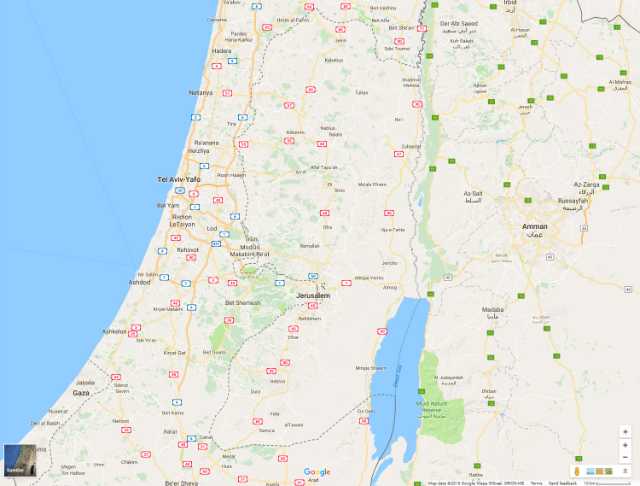
Palestine does not exist on the map and is also not easy to find in the jam-packed schedules of diplomats working with the Middle East.
A was unleashed a couple of weeks ago when among pro-Palestinian activists that Google had removed Palestine from its mapping service. The internet ignited as only the internet can. The hashtag went viral, accompanied by demands that Google reinstate Palestine on its map.
It turned out, as happens from time to time, that the rumour mill was quite simply ill-informed. Google rejected the story. It had certainly not deleted Palestine from its map. In fact, it added, Palestine had never featured on Google Maps. A search for 鈥淧alestine鈥� in Google Maps brings up a map of Israel, with dashed borders demarcating the West Bank and Gaza Strip. Google鈥檚 problem was a 鈥渂ug鈥� in the system. The bug had caused the dashed lines only to be displayed on the map, while the place names 鈥淕aza Strip鈥� and 鈥淲est Bank鈥� had been erased from the system. Could there be a more apposite metaphor for the situation of Palestine 鈥� and the Palestinians 鈥� today? Probably not.
Palestine as an issue has gone off the international community鈥檚 radar. The reasons for this are many and complex. In reality, it is not just one bug but many that are causing major problems for the international system. These include the war that continues to rage in Syria, the struggle against IS, the collapse of Iraq, war in Yemen, and chaos in Libya. To this gloomy picture one might add, among other things, the immense refugee crisis that is bringing regional host nations to their knees, Russian interference, the uncertain future of the nuclear deal with Iran, an increasingly authoritarian military regime in Egypt, and the attempted coup in Turkey. The list is long 鈥� and this only covers the Middle East! In the context of all these problems, it is not surprising that the Israeli-Palestinian conflict has fallen off the agenda.
In Obama鈥檚 speech on the status of the world as seen from Washington D.C. to the General Assembly during last year鈥檚 high-level week at the UN, the Israel-Palestine conflict was left unmentioned. The low-priority rating of the conflict was confirmed in a . The interviewee is Obama鈥檚 adviser on the Middle East, Robert Malley, an old hand among Washington鈥檚 foreign policy elite. Earlier in his career, Malley worked mainly on the Israel-Palestine portfolio. Precisely the same description can be ascribed to Malley鈥檚 interviewer, Aaron David Miller. Both men worked closely with the conflict and were involved in unsuccessful peace negotiations.
But this is all in the past. The conversation between the two men is dominated by IS, Iran, Syria, chemical weapons and relations with Russia. Obama came to the presidency promising to end the wars in the Middle East. Now that he is due to step down in six months, the situation is almost the opposite of what he wanted: the United States continues to be locked into a destabilized region that it cannot fix, but also cannot leave.
How much responsibility do Obama and his administration bear for this situation? Should the United States become more heavily involved in these wars, or should it turn its back and withdraw completely? And what would be the long-term cost of doing so? Recent developments suggest that any space vacated by the Americans does not remain vacant for long. A number of other parties 鈥� both governmental and non-governmental 鈥� are ready to step in. Regardless of whether it is a woman or a clown who moves into the White House in January 2017, from day one the Middle East will present the new president with a mountain of dilemmas and practical political considerations he or she will have to manoeuvre around. (And if the new president is not a woman, God help us all.)
According to Robert Malley, the Obama administration鈥檚 priorities for these final six months are the fight against IS and following up the Iran nuclear deal, as well as pursuing political solutions in Syria, Yemen and Iraq. The Israel-Palestine conflict is mentioned mostly out of habit. The administration is keeping itself at arm鈥檚 length from this conflict. The administration sees diplomacy as a fragile and somewhat rare commodity, whose credibility should not be frittered away on processes that everyone knows are stillborn. And one can hardly blame them. If there is one process that fits this description, then it is the peace process between Israel and the Palestinians.
Rather than talking about talking, which might well be said to have been modus operandi over recent years, the administration is now prepared to help create the right pre-conditions for 鈥渕eaningful鈥� negotiations. What kind of pre-conditions might these be? At this point things become vague. Both Palestinian and Israeli leaders speak often about the pre-conditions for peace, but they rarely agree about what they are. For the Palestinian leadership, one such pre-condition has been the recognition of Palestine as an independent state. 136 countries have already done so, but the United States is not among them.
The closest that the Palestinians have come to an American recognition was perhaps in the autumn of 2012, when on its system. With the exception, of course, of Google Maps.
- This text was first published in Norwegian in the daily newspaper Dagsavisen 23 August 2016: 鈥樷��.
- Translation from Norwegian: Fidotext
Related comments