An Impossible Peace
Posted Wednesday, 12 Oct 2016 by Kalle Moene
The FARC and the Colombian government deserved to share this year鈥檚 Nobel Peace Prize. Unfortunately, however, the prize was awarded to only one party. In general we are idiots if we let political correctness govern our views about how the world works. We confuse facts with latent sympathies 鈥� a widespread form of intellectual dishonesty, disguised as good manners. Political correctness also influences our thinking about the current and past state of the conflict in Colombia 鈥� and about who deserves to share the Nobel prize.
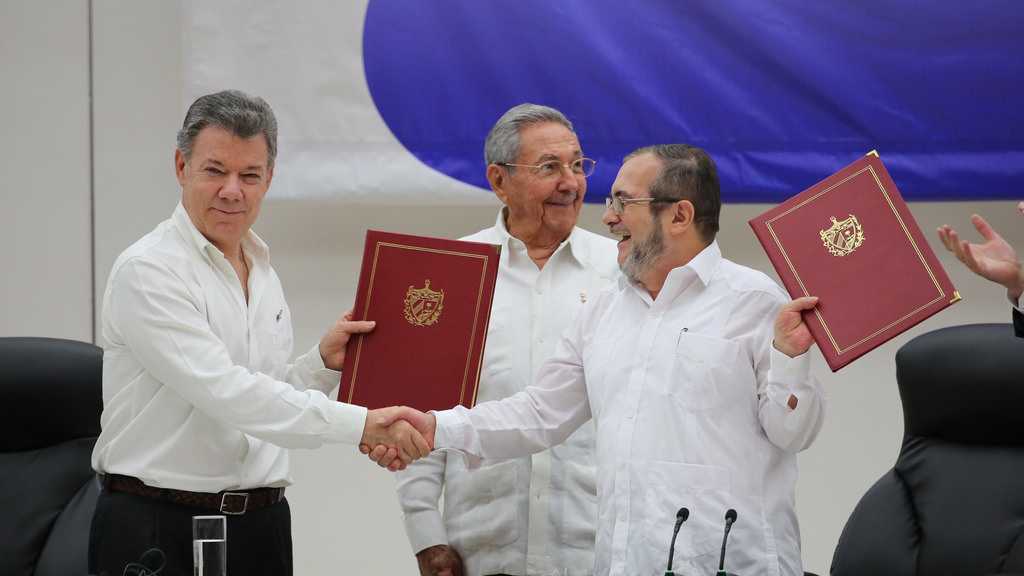
As is well known, the FARC rebels and the government are not the only parties active in the conflict in Colombia. Other guerrilla movements, such as the ELN, are also involved, as well as various paramilitary groups and drugs gangs. Accordingly, achieving peace requires striking a difficult balance between what may be consistent and fair and what may result in a lasting settlement. Insisting on complete justice today, as former Colombian president Alvaro Uribe did, may create an obstacle to peace in the future. At the same time, lasting peace may depend on reducing the grotesque inequalities in Colombia with regard to income, wealth and political influence 鈥� inequalities that in the past led to the conflict.
Even in Colombia, however, many people believe that the FARC started the fighting. But the FARC was founded in 1964, long after the fighting commenced. Between 1948 and 1958 alone 鈥� a period known as 鈥溾�� 鈥� more than 200,000 people lost their lives in violent confrontations between the Conservative and Liberal parties in Colombia. Subsequently these two parties formed a coalition in order to prevent other, more radical, parties from gaining influence. So the FARC did not start the war 鈥� it was the war that started the FARC. The organization was founded by poor farmers as a self-defence initiative. The farmers were under attack by government forces, backed by the United States, targeting rural communities with Communist sympathies. Of course, this does not alter the fact that FARC rebels have committed many atrocities.
But which side has really been responsible for the most violence? Long ago the United Nations calculated that the FARC and the ELN . The rest were caused by government forces and paramilitary militias acting in concert with criminal gangs. Finally, it is politically correct to believe that people from all parts of Colombian society last weekend (50.2 per cent voted 鈥渘o鈥�, with a turnout of 38 per cent). The figures suggest otherwise. With the good help of economist and political scientist James Robinson, it is easy to see that the percentage of 鈥測es鈥� votes was high in provinces with many poor voters, while the percentage of 鈥渘o鈥� votes was high in provinces with few poor voters. The division between urban and rural areas was equally clear. The largest cities (with the exception of Bogota) had a majority of 鈥渘o鈥� votes, while most rural provinces had a clear majority of 鈥測es鈥� votes. Since nearly three-quarters of Colombia鈥檚 population live in urban areas, the preponderance of 鈥測es鈥� votes in rural areas was much higher than the preponderance of 鈥渘o鈥� votes in cities. The proportion of 鈥測es鈥� votes was also highest in the areas most directly affected by the civil war 鈥� such as Choco Province in north-west Colombia, where 80 per cent of voters voted 鈥測es鈥�.
All in all, the distribution of 鈥測es鈥� and 鈥渘o鈥� votes is a frightening reflection of the same conditions that previously led to the violent conflict between the government and the FARC. For over 100 years, urban elites have shown little interest in conditions in rural areas. They have ceded power to the largest landowners, who together with paramilitary militias, have acted as de facto governing authorities locally.
Most people who have been directly exposed to this bad governance voted 鈥測es鈥�, while those who have been little affected were slightly more likely to vote 鈥渘o鈥�.
Another factor was Hurricane Matthew, now causing a state of emergency in the United States, which passed through parts of Colombia during the referendum. The figures show that the hurricane prevented many people in rural provinces 鈥� where support was greatest for President Santos in the 2014 general election and where most people were likely to vote 鈥測es鈥� 鈥� from voting. Without the hurricane, there would in favour of the peace agreement.
In any event 鈥� and as suggested by Jon Elster many years ago 鈥� it is no doubt true that the maximum punishment that the FARC is prepared to accept for its atrocities is lower than the minimum punishment demanded by the urban elites in order to gain the acceptance of a peace agreement. But one must consider these attitudes in light of Colombia鈥檚 extreme inequalities in income and political influence, and in light of those who will bear the burden of any continuation of the conflict.
Although the best solution would have been for the FARC and the Colombian government to have shared the Nobel Peace Prize, the award of the prize may nevertheless put the peace process rapidly back on track.
- This text was first published in Dagens N忙ringsliv 8 October 2016: 鈥淒en umulige freden鈥�
- Translation from Norwegian: Fidotext
Related comments


