Book club review: Savage Ecology - War and Geopolitics at the End of the World
Posted Monday, 13 Sep 2021 by Adam Freeman
Pardon me, I was dreaming; I forgot you are here
waiting for me to accept you again, tell you that you’re not dangerous. Alice Notley, Above the Leaders
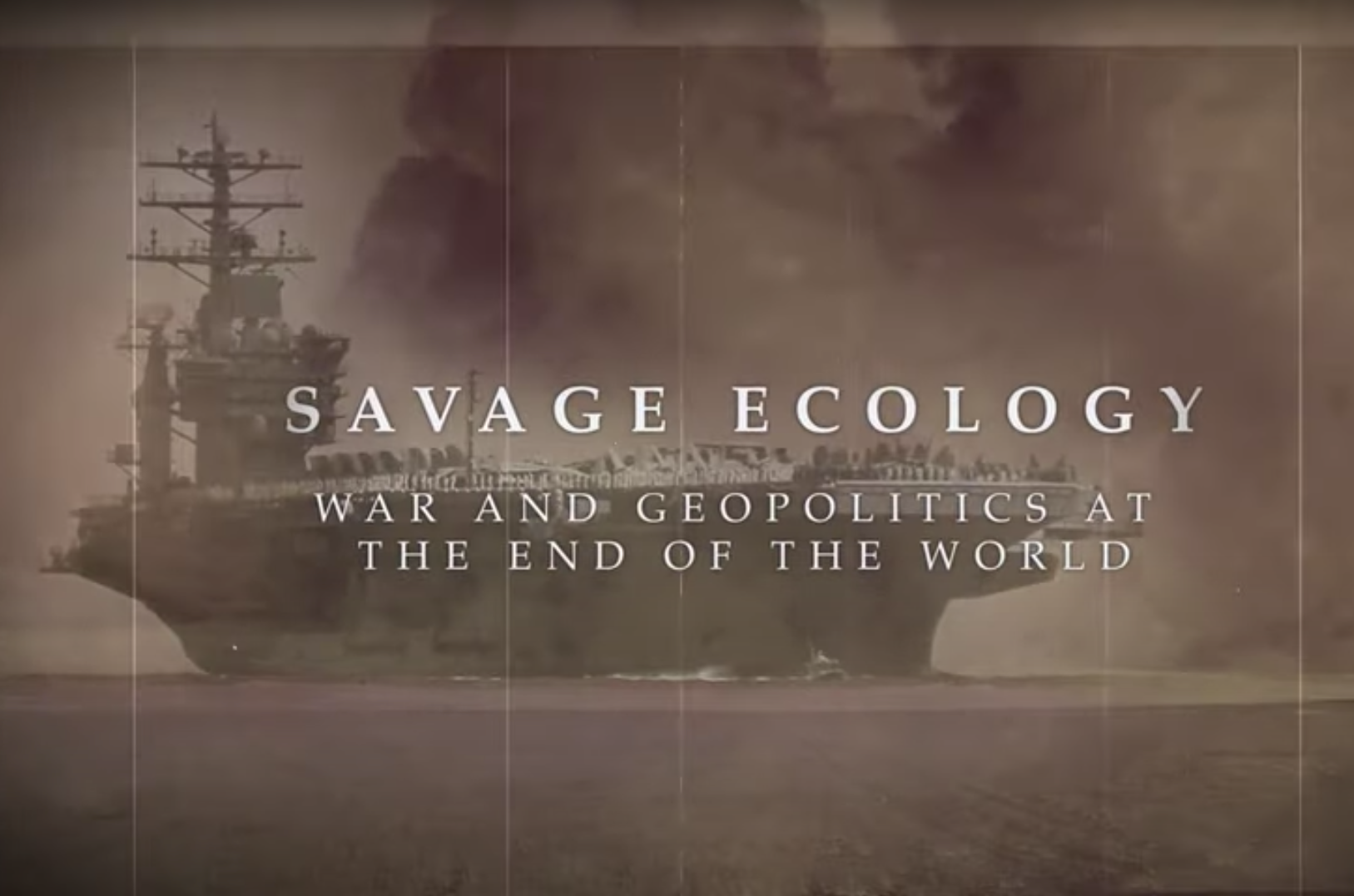
With the global security system implicated in just about every scenario of civilisational and species collapse, should it be said that scholars have given too much time to chattering about geopolitical fact patterns, or actually not enough? Jairus Grove, in his 2019 book Savage Ecology: War and Geopolitics at the End of the World, poses that inhabiting modernity’s lethal “effects” anew can itself contribute to re-directing and, to a needed extent, “de-directing” human purposes.
Whatever’s to be said about ancestral, cosmological, or evolutionary origins of unbound power and, eventually, the world’s aggressive and techno-powered unification, Grove especially doesn’t want covered up the “elite-driven Euro-American geopolitics of industrialized war and capitalism made ecocide that is now a global historical fact” (pp. 10-11). His chapter “A Martial Logic of the Eurocene” references Peter Sloterdijk for the latter’s use of First World War gas attacks to exemplify a signal moment at which even one’s environmental milieu was made a vector of annihilation (p. 82). If this is the very escalation of the history of violence confronted in Wilfred Owen’s poems—like “Exposure” (published posthumously in 1920), with its “bullets […]. / Less deathly than the air”—Grove mentions land clearances, species eliminations, and urbanisations on the American continent as earlier manifestations of the same directed development of suffering (p. 98). Scanning “the terrain of apocalypse and war” on behalf of those “moderns no longer interested in being along for the ride”, Savage Ecology affirms, however, that even a “tortured topography” carries with it “a world of persistent provocations”—of vibrancy, of fragility. “[T]hinking is at its best when it is along for [that] ride” (pp. 229, 282, 12).
The signature-evasive-manoeuver of Grove’s politics is represented in a sci-fi horror tale that appears as Savage Ecology‘s closing pages (pp. 281-284). With this story set in the early 2060s, Grove faces readers with the latest in a long line of ghoulish imaginings of Los Angeles. His brief narrative unfolds cimematically as a drone’s camera “pans down […] in a wide landscape shot” to surveil an electrically reanimated army advancing on a military compound. With overhead footage of zombies capturing war’s would-be relentlessness, Grove’s amassing victim-killers have been joined by a newest recruit whose dying words are recorded: “we are not who we are”. What soon plays out, however, is a resonant, yet less joyless, diversion. The flying killer robot spies its own beauty over the ocean—“titanium wings outstretched”—and becomes momentarily a transport of delight. In this way, rather than allow himself to indulge an over-libidinal end-of-days narrative—perhaps by a plotline in which every unmarked data point gets revealed as just an enemy, or a hero, we haven’t yet met—Grove’s “postvision” (p. 9) portals to a world where at least some-body stops considering itself according to the shooting script of a filmmaker in the sky.
Grove accuses usual suspects of political closure: those who entertain plans to harness and husband the Earth at scale. But the book also calls out the bearers of what attempt to pass as more benignly or virtuously transformative solutions. Liberal managerialists or global revolutionaries offer little more than other definers and exploiters of the future to model the thought of ever giving up vast power. And in the meantime, of course, they pull focus from alternative worldly experiences. Grove’s “protean” politics thus instead positions itself outside the conventionally “political” in magnetising to a “complexity of human and nonhuman assemblages [that] alters the expected provocateurs as well as tactics” (pp. 258-259). Without insisting that “the world slow down”, a savage ecologist cultivates responsiveness to what shifts or what mutates, what surges or what melts, what coalesces, and that at any rate, animately or inanimately, has “life of its own” (pp. 230; 264). She adventures “weird[ly]” and “creative[ly]” with the things of the world to “unblock certain flows corralled by the arborescent strategies of fortress state craft” (pp. 17; 230).
A “planetary struggle for homogenization” (p. 50) will have been no politics, and no struggle, if it always decides for whatever the Eurocene has “built back” itself. Yet notwithstanding Grove’s impatience with giving “politics as usual” any more time of day, I am curious when it comes to whether the savage ecologist really does best in walling off the part of life’s tableau that overlaps consensus reality. For instance, consider the “ability” heard by Donna Haraway (2016) in “responsibility” as it bears on engaging forgotten others. Is it definitely not the case that intonations like this, response-ability, ever come to brush souls with the very aligners of the world? Do none ever catch sight of others rooms, as it were, in the rooms where they are? Are there no secret savage ecologists, out of place, maybe unaware, and passing over and over again into silence? To be sure, Grove’s own bearing, operating deep within and yet simultaneously beyond International Relations (IR) theory, should probably not be imagined to be without counterpart in other professional realms.
After a sequence on the “Great Homogenization” (pp. 33-110), as engendered in the book’s judgment by the Eurocene, and before a third part titled “Must We Persist to Continue?” (pp. 227-272), Savage Ecology‘s middle chapters file investigations into a trio of “Operational Spaces” (pp. 111-189): (1) killer materials spread by security forces, repurposed in motlier ways by insurgents (“Bombs”); (2) varicosed circulations of blood feeding a politics of racial hierarchy (“Blood”); and (3) the problematique of neuroplasticity for a coming neuropolitics (“Brains”). To go over just the first, we have the stylishly volatile “matter” of Grove’s “Bombs” chapter: the Improvised Explosive Device (IED). Knocked together using “weapons left behind” and a “deluge of electronic waste shipped, dumped, and smuggled throughout the Global South” (p. 130), the weapon that re-wilds the master’s tools speaks for “things” whose intimacy with the system can be one of culmination or betrayal. So far as it’s hoped that becoming attentive to things needn’t involve reorienting to technology, reflection on the IED offers an occasion to note that the dimensions of this issue could presently be said to have unworked its own tensions. A collapsed relation between means and ends in view of an apocalyptic endgame: such is, after all, Grove’s new geopolitical thought to craft with the natural and the made without treating either as “under construction” or as “raw material”.
A passage late in Savage Ecology aims at embracing all that blasts away the single firing range of experience owing to “elite-driven […] geopolitics”. Yet somehow this vigorous moment isn’t everything it could be. Thus, in “Apocalypse as a Theory of Change”, Grove embeds an epiphanous list of possible becomings, to wit, an Improvised Explosive Linguistic Device (IELD):
Becoming agonistic, becoming active, becoming rage, becoming justice, becoming quiet, becoming still, becoming disobedient, becoming graceful, becoming kind, becoming indifferent, becoming defiant, becoming gentle, becoming sacrifice, becoming fire (as many monks in Vietnam did and at least three individuals in the United States have in the face of the Iraq War), becoming generous, becoming courageous, becoming feral … (p. 230).
A next paragraph says geopolitics cannot be “disowned”, only, indeed, “diverted”; but marks the channels for this diversion as running toward “arguments, justice, compassion, forgiveness, politics, resistance, grief, art, beauty, the world”. It is as if the text, right away, moves to hedge the likes of ferality, disobedience, ¾±²Ի徱´ڴڱð°ù±ð²Գ¦±ð… Indeed, the paragraph at the foot of the page that includes Grove’s “IELD” (not his term) soon also refuses rage among the “practices, bodily dispositions, emotions” appropriate if one wants to “externalize or banish the Eurocene”. Do such selections begin to set up a nominally gentler matrix for history rather, in fact, than hold moments open to events and arrangements happening unprogressively on their own time?
This seems plausibly to be so. In step with William Connolly, Grove asks explicitly for “care” in welcoming the unheard, unthought, and warding off “indifference to the cutting edges of change that can be violent and dismissive” (p. 266). Yet consequences arise from his employment, again via Connolly, of the theorist-as-“seer” (e.g., p. 239). Thinking on what it would be to become or to encounter such an insistent shepherd of re-beginnings, and leaning in to becoming’s many-many-sidedness, wouldn’t the trans-political seer be a character occupying intensely paradoxical moments? That Euro-American refinements and globalisations of violence are vulnerable to being described as careless and oblivious to care does not make the opposing quality the calling card of A-list seers. My mind runs to a poem of Alice Notley’s that operates the shamanic genre of a healing ceremony: “I don’t care about you. I do it for the joy of it” (2016, p. 104).
“Becoming” itself isn’t above critique. What describes the seer’s refashioning of command if not that she, indeed, models paradox, but also teaches that if being forks-and-forks-and-forks this only truly divides possibilities if the direction and very condition of flow is part of what gets unmade in the passage? Hence, the atom bomb, styled by Sloterdijk as itself a sort of oracle, “the only Buddha that Western reason could understand”, he pictures as possessing, among its other qualities, “infinite” “calm” and “irony”. It resides inside of time but also outside it as an “extreme objectification of the spirit of power” (1987; p. 130). Grove’s seer, “fortune-teller”, supposedly isn’t in the business of patching back through to teleology: she deals in “incipient possibilities, not catastrophic certainties” (p. 264). All the same, “becoming” as a keyword seduces minds to devise a pattern for time’s energies as if one had defined their conditions. This is almost to say that to unite one’s affirmations around it is “becoming boring”.
And what if the seer is blind, or doesn’t only look? Typical of traditional understandings of the senses, Grove emphasises “[looking and listening] for the incipient”, and also incorporates touch—in recommending, for instance, “[allowing] yourself to be touched rather than always touching” (pp. 253, 270). As unsurprisingly, he says less, especially positively, about smell and taste—but for a few citations envisioning that a species “[smells its] extinction”, or that the colonialist secures himself a spot to “enjoy the smell of his own shit”; or where, regarding neurochemical interventions, Grove quips that “once mythical muses may soon be swallowed or inhaled” (pp. 186, 198, 167). A savage ecologist may have to anticipate a period of reflection not only on the sufficiency of her eyes and ears but also on “sensation” as a concept with its own weightedness, history, and limits.
A question of whether Grove’s use of “sensation” is sufficient to itself, or for that matter to all the ways in which people receive ideas, and gauge the weight of what they manage to sense, closes in again on the relation of savage ecological practice to that play of interior images whose practical embodiment is poetry. Grove matches the contemporary considerations of poets in mourning the murders and starvations of languages of recent centuries. At the same time, the official course of his argument gives verbal languages wide berth on account of their exclusivity within the possibilities of the “corporeal” (p. 258). But languages—by their revisionings, veerings-off, their frail vibrations—are complicit not only in death-dealing unifications and expulsions but also in methods for introducing lightness, fluidity, life. Thus, for instance, Ta-Nehisi Coates, in a quoted passage, calls for “actions over states”, “struggle over hope”, but also “verbs over nouns” (p. 17). What if, regarding this, one should remix Grove with IR writers who sense “beyond the catastrophe of our times […] a more poetic subjectivity” (Evans and Reid 2014, p. 203)?
Savage Ecology in fact opens onto a Walt Whitman poem—“As I Sat Alone by Blue Ontario’s Shores”—which, into the folds of “you and me”, names, among others, “power, weapons”, “lies, thefts”, “war”, “America”, “Natural and artificial”, but also “Freedom, language, poems, employments”. Later linking Whitman to Kerouac and Ginsberg—and he could have named Gregory Corso, and his “BOMB” (1960)—Grove illustrates inheritances of form generally with poetic “procreation” (p. 262). He offers early on that “We can study airports, poetry, endurance races, borders, bombs, plastic, and warfare, and find them all in the world” (p. 27); not to mention that, throughout, the written prose of Savage Ecology itself is metaphoric, characterful, honest. Might its author, then, have oriented more evenly among thingly and oral particulars—if not toward a “poetic subjectivity”, toward a selectivity without prejudice, a response-ability, in the passing of any resonance? —in the object world, okay, but also in the voices, or better, tongues, that try to speak the world of things.
Nowhere even does Grove decipher the particular thought-shape of his book’s title, which thus awaits readers like a puzzle in relating destructuring and aliveness. So, if one might try puzzling it out: Might “savage ecology” be the script stuck to by that species whose performance of a self-centred cosmos begins chewing the scenery? Does it name a world of dangerous things as well as what Eurocene-tric humans had denied about nature? —the IED become Gaia, or Gaia as the ultimate in improvisatory explosiveness. Zooming in, the charged word “savage” relates to the “wild”, out of the Latin, silvaticus: “of the woods”. Savage ecology, then, goes to forest ecology, and so a certain combined de-territorialisation and re-territorialisation. To be sure, when Grove refers to arborescent strategies of fortress state craft, it’s practically to juxtapose managed and legible to other more labyrinthine tree-scapes.
Thus, the metaphorics themselves already regrow a thicket of non-knowing—where discovering new details, or finding out what’s happening, can be matters of bodily or imaginative migration and not of gaining a security clearance or deferring to an expert. “Ecology”, for its part in this, stems from the Ancient Greek, oikos²¹²ԻåÌýlogos. Former term binding to the household, the latter to a putatively unifying discourse, a savage ecology, besides, then, being a forest ecology, is also a savage—a²õ violent, yet also as forest-like—discourse on the home as well, indeed, as a discourse on the home as the forest, and it could even indicate an orderly forest household. Grove does discuss oikos as common core of “ecology” and “economics” (pp. 121, 131). Yet a missed reflection via logos would go to a surplus vibrancy and unsurpassable fragility of that which formats a household but never solves for its own polemicism. The expression “Savage Ecology”, hence, certainly itself lends to explosions of thought that themselves teem with (de)composition.
Despite the woodsy title, when offering readers a lived-in feel for “incipience” Grove’s exemplary landscape isn’t the forest—or the “grove”—but a different scene of ignorance before excessive beyonds: the shore. Via Foucault, we’re asked to anticipate modern “humanity” “erased like a face drawn in sand” (p. 186). Later, before probing whether the sandprint “irreversibly alters the pattern on the beach”, Grove evokes an “essential experience” marking humans as bearers of “thingness”. “Try”, he poses, “giving up and allowing the cross-current of the ocean to drag you down shore” (pp. 270-271). —Maybe there’ll be no irreversible human alteration, regardless the over-representations of the Eurocene. And yet, even as certain ends of the world are arriving, embodied and poetic gestures can go on energising, encapsulating, and prolonging new intricacies and successions. To be sure, Grove’s argument having already put the “emergence” in “emergency”, a kaleidoscope of temporalities may already be felt to await transcription at the tips, and beyond the idea, of our senses. Thus, has the body buoyed by waves tired itself, or is it calming itself, in desiring to convey something else to other islands of experience? As Grove concludes in his own voice before pressing play on his postvision: “I am experimenting with the role of the seer in order to push further into the metaphysical fallout of cosmic fragility” (p. 280).
Grove writes of an “academy of refuge”, a discipline of “deviants” (pp. 26-27). To this army of the Euro-unseen, Savage Ecology offers an immersive initiation: a book desirous that what Notley in her ceremony calls the “machine I must be part of, causing planetary death” be morphed ²¹²ԻåÌýmaterialised into a school of life through the act of reading (2016, p. 110). With sources ranging from pop culture to military manuals via Mearsheimer and DeleuzeGuattari, the book lives large even in dreaming of lying low. A decision to sign-off—below the remark about “metaphysical fallout”—with a call to “#DIFFERENTIATE #SPECIATE” could, like priority lanes for “care” or “becoming”, be deemed over-doctrinal (p. 280). But such an expression—doubling, multiplying, as a mission statement and as a plea or epiphany—could as well resemble a movement of transforming-becoming. Landing readers in a thoughtscape designed for the rolling aftermath rather than in decisional anticipation of military and economic geostrategies—a scene in which expectations of the worst aren’t met by projects and projections of global betterment but by glimmers of “[lives] worth repeating” in the transpiring struggle (pp. 26-27)—Grove conspires to elevate the output of IR theory, and, more than anything else, its passion.
Savage Ecology: War and geopolitics at the end of the world by Jairus V. Grove. Durham, NC: Duke University Press, 2019, 368pp. ISBN: 978-1-4780-0484-4
For more about this book, read Michael Murphy’s to this book-review section.
References:
Evans B and Reid J (2014) Resilient Life: The Art of Living Dangerously. Cambridge: Polity, 208 pp.
Haraway DJ (2016) *Staying with the Trouble: Making Kin in the Chthulucene.*Durham, NC: Duke University Press, 312 pp.
Notley A (2016) *Certain Magical Acts.*New York: Penguin, 144 pp .
Sloterdijk S (1987 [1983]) Critique of Cynical Reason, trans. Eldred M. Minneapolis: University of Minnesota Press, 600 pp.
Related comments


