Book review: The Suspect: Counterterrorism, Islam, and the Security State
Posted Wednesday, 4 May 2022 by Thom Bolland
by Rizwaan Sabir, Pluto Press, 2022, 256 pp. ISBN: 9780745338484
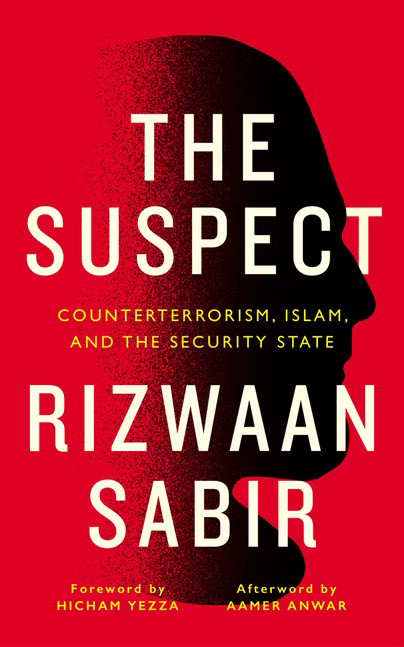
The contemporary surveillance state of the UK and its allies is in many ways the bureaucratic par excellence, with its logics, language and processes operating through seemingly deliberate and elaborate sets of contradictions and linguistic sleights-of-hand. It is simultaneously vague, due to its characteristically administrative and ambiguous tone, yet clearly racialised and politically focused on its targets; it is surreptitious whilst continuing to post explicit and intense reminders of state power; and it is detached ā€“sanitisedā€“ though, nevertheless, deeply personal, violent and traumatic. In The Suspect: Counterterrorism, Islam, and the Security State, Rizwaan Sabir highlights these points through a first-hand account of how, as a Masterā€™s student at the University of Nottingham in 2008, he was arrested and detained under the UK Terrorism Act 2000 for downloading a document named the ā€˜Al-Qaeda Training Manualā€™ as a part of his postgraduate dissertation on Al-Qaeda in Iraq. A document, we are soon to discover, freely available to download from the US Department of Justice website (as well as other government sources), accessible via the University of Nottinghamā€™s own library services, and able to be purchased in various UK high-street bookstores such as Blackwellā€™s. It is by design that the documentā€™s title is suggestive of nefarious and underhanded intentions, as the document ā€“an easily accessible ā€˜compilation of material drawn from various military, intelligence and law enforcement manualsā€™ā€“ was previously rebranded as the ā€˜Al-Qaeda Training Manualā€™ by US prosecutors to link US Embassy bombing suspects to Al-Qaeda, and, conveniently, create a guilt-by-association framework for future counterterror profiles and arrests. From this, Sabir is subsequently and swiftly drawn into the nexus of profiling, surveillance and counterterror pre-emption that permeates the day-to-day functions of present Western states.
ā€˜The Suspectā€¦reads as an examination and critique of the routine and assumed-as-neutral logics that strengthen and give shape to the legitimacy of the surveillance stateā€™
At its core, The Suspect contributes an understanding of how ā€˜typicalā€™ security practices such as profiling and surveillance are contingent on the creation of insecurity, and ā€“contrary to conventional wisdomā€“ the unexceptional nature of this. It chronicles how surveillance processes are increasingly normalised, articulated as mundane and legitimate by the state in order to pre-empt and monitor security threats (as well as co-opt dissent), and, from this, become largely accepted by the wider public ā€“ a seemingly meagre cost in order to live in a ā€˜safeā€™ liberal democracy. However, the account that Sabir puts forward is a detailed and vivid rebuttal of the moral and practical legitimacy of such perspectives, and a testimony of the wider harms that, incidentally or strategically, are often lost through attempts to navigate the mystifying labyrinths of bureaucratic process. Here, harm and insecurity are not framed as transgressive, rogue elements, but functional parts of the derivative, contested make-up of ā€˜securityā€™. Consequently, The Suspect renders visible ā€“and draws together the theory and practice ofā€“ this contingent insecurity, broadening and deepening our appreciation of what could or should be a focus of our ā€“criticalā€“ attention. As such, it is a book that should be of great interest to those concerned with the politics of (in)security, state power, surveillance and its harms, and the racialisation of counterterror practice.
As noted, it is easy to see Sabirā€™s story as an exceptional, singularly erroneous form of over-reach conducted by the security state, yet he is clear in making the crucial point that his tale is but a single traumatic node in the wider, established, process and bureaucracy that ceaselessly profiles, monitors and interferes in racialised lives. The single raindrop never feels responsible for the flood, so the saying goes, and this thought would frequently return to me over the course of The Suspectā€™s 200-plus pages. Across the book is a clear understanding of how completely embedded and routine surveillance measures are towards racialised populations, and the depth and breadth of those individuals and institutions who, willingly or implicitly, contribute to their functioning. Indeed, one cannot help but notice the rota of ā€“almost surrealistā€“ individuals who, working as components within the grander security apparatus, offer sympathetic (and sometimes empathetic) condolences to Sabir as they continually intrude, provoke and cause lasting harm: ā€œI am Italian, and I am sometimes stereotyped as being part of the Mafia so I know how you must be feelingā€, one Department of Homeland Security agent nonchalantly tells Sabir after questioning him in an interrogation room at JFK Airport. Drip, drip, dripā€¦
The Suspect, then, reads as an examination and critique of the routine and assumed-as-neutral logics that strengthen and give shape to the legitimacy of the surveillance state. Nevertheless, it is also an intimate and personal answer to a question, the implications of which are all too frequently understood by those who were, or still are, the obsession of the state: what happens when its focus and resources are groundlessly fixed on you and those you care about ā€“ is the price, then, a meagre one? To this, Sabir invokes his experience of the confusion, dissonance and cascading strains attendant to what one could reasonably label the contemporary panopticon. What is evident across The Suspect is that oneā€™s awareness of the stateā€™s shapeless remit is, in and of itself, a key feature of surveillance and its consequent disciplinary power. Although you may live in full knowledge that you are a ā€˜person of interestā€™, you will almost certainly not be cognisant of the particulars underpinning your surveillance. Paradoxically, when one attracts the attention of the state, the ambiguities which constitute its response(s) become increasingly apparent. What is inferred from this is the potent, stupefying appreciation that at any moment you may be the focus of a capricious and formidable gaze. The ensuing reaction to this is, , that contingent logics of discipline and control are internalised and consolidated to form a continuously self-policing, and subsequently compliant, subject. It is control that not only endures but does so from a distance, both in space and time; it is the creation of lasting insecurity through securitisation.
ā€˜Sabir invokes his experience of the confusion, dissonance and cascading strains attendant to what one could reasonably label the contemporary panopticonā€™
During the writing of The Suspect, a decade after his initial arrest, Sabir describes how he still felt that his ā€˜entire existence [ā€¦] was exposed to the surveilling eyes of the security and intelligence servicesā€™. Whilst lecturing, Sabir notices an unfamiliar face in the crowd, someone who is not a student: a ā€˜middle-aged man [ā€¦] frantically taking notes of everything I saidā€™. Stress levels increase and Sabir starts to wonder if he is an intelligence agent briefed to log Sabirā€™s research on counterterrorism, if his presence is an intimidation tactic, or simply there to ā€˜send a messageā€™. It transpires, after several deflective responses, that the man is a ā€˜note takerā€™ for a student entitled to additional learning support. Nevertheless, Sabirā€™s reflection is a significant one: ā€˜the traumatic and harmful effects [of the stateā€™s legally sanctioned violence] were still looming over meā€™. At several other points, Sabir recounts how the UK governmentā€™s creation of him as a surveillance subject leads him down avenues of paranoia, distrust and helplessness. It is an insightful, brave and fundamentally necessary component of the book. It captures the personal costs and harms of surveillance that are too frequently ignored, swept away and justified by those in power, and it is a counter to the fatuous idea ā€“habitually put forward by the surveillance state and its lackeysā€“ that (and please proceed about your business as normal).
ā€˜Once you are marked as a ā€˜ā€˜subject of interestā€™ā€, Sabir notes, ā€˜it is difficult to become ā€˜uninterestingā€™ā€. The ease with which one can be placed into the category of ā€˜suspected terroristā€™, and the subsequent revocation of fundamental rights, should not only trigger alarm bells inside the minds of citizens within liberal democracies, but the ongoing harms inflicted from such ā€˜routineā€™ acts should be widely understood by the same citizens as a shameful and continuous moral failure by the state. Furthermore, these are harms which are too often and too easily overlooked when, conceptually, we assume security is merely ā€˜state-centricā€™. The Suspect is a crucial account of the personal and communal costs of surveillance, profiling and (in)security, and can be understood through the lens of resistance, not least due to its content, but also through Sabirā€™s closing recommendations to assist in helping those affected by the stateā€™s counterterror measures. Attendant to these are notions of defiance and healing, yet we are also implicitly invited to consider other wide-reaching questions: What harms are missed when our focus is too narrow and superficial? What possible avenues for human emancipation have been preventatively stifled by these logics? how do we affect the modern security agenda?
It is perhaps unsurprising that there is a short reference to George Orwellā€™s novel, 1984, in The Suspect ā€“ unsurprising because, after all, who better to show us the dystopian horrors of routine, bureaucratised, authoritarian, surveillance practices than the person behind ā€˜Big Brotherā€™, ā€˜doublespeakā€™ and ā€˜the capturing of the inner mindā€™? However, it is a different piece by Orwell that I feel is more suited to signify Sabirā€™s contribution. In , Orwell champions the ā€˜power of facing unpleasant factsā€™, and the desire to ā€˜push the world in a certain direction, to alter other peopleā€™s idea of the kind of society that they should strive afterā€™. To resist the surveillance state and re-calibrate our assumptions surrounding security there are many unpleasant facts that one has to face head-on ā€“ The Suspect provides a number of these unpleasant but necessary truths first-hand, and emphasises the urgency with which we have to contest them.
ā€˜The single raindrop never feels responsible for the floodā€™
Related comments