Book review: Biopolitics After Truth: Knowledge, Power, and Democratic Life
Posted Thursday, 5 May 2022 by Regan Burles
by Sergei Prozorov, Edinburgh University Press, 2021, 192 pp., ISBN: 9781474485784
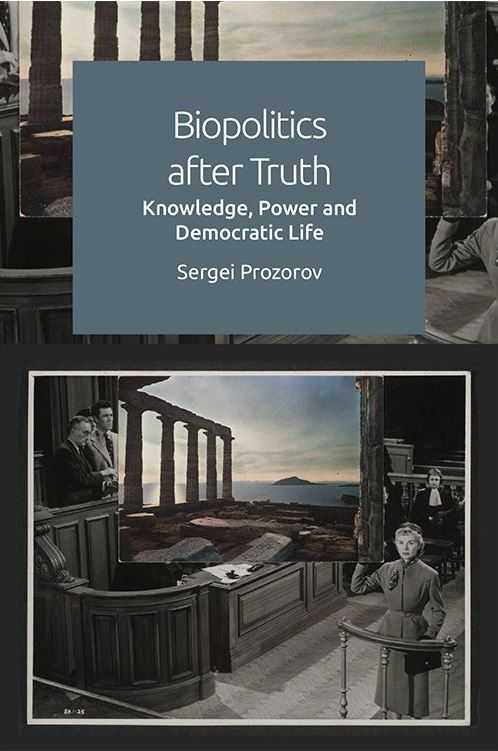
Rarely does a book of political philosophy manage to triangulate three themes of public interest as effectively as Sergei Prozorovā€™s Biopolitics After Truth: Knowledge, Power, and Democratic Life (). Its main topicsā€”biopolitics, ā€˜post-truth,ā€™ and post-Soviet Russiaā€”not only speak directly to pandemic politics but also address the relationship between Russia and the West that has become a matter of intense public concern since the election of Donald Trump and Russiaā€™s invasion of Ukraine. The latest in a trilogy of books on biopolitics written by Prozorov and published by Edinburgh University Press, Biopolitics After Truth extends and combines Prozorovā€™s earlier analysis of Soviet biopolitics in Ā The Biopolitics of Stalinism: Ideology and Life in Soviet Socialism () and theory of affirmative biopolitics developed in Democratic Biopolitics: Popular Sovereignty and the Power of Life () in order to diagnose the problem of post-truth and provide a strategy for resistance to it. The book weaves together continental philosophy, contemporary political theories of post-truth, and a study of post-Soviet politics with clarity and concision to diagnose the emergence of post-truth authoritarianism. In doing so the book engages debates in international political theory, security studies, continental philosophy, and studies of Soviet and post-Soviet Russia, and will be of interest to scholars of these topics.
ā€˜The book weaves together continental philosophy, contemporary political theories of post-truth, and a study of post-Soviet politics with clarity and concision to diagnose the emergence of post-truth authoritarianismā€™
Prozorov takes pains to distinguish the post-truth condition from the simple observation that political actors lie and the ancient observation that there is a relationship between knowledge and power. The worry is that dismissing post-truth as ā€˜nothing newā€™ risks a passivity or indifference that is itself the result of a post-truth condition. For post-truth, in Prozorovā€™s account, is about indifference to the question of truth rather than a questioning of truth or the promotion of lies. It is what Prozorov, drawing on Alain Badiou, calls a ā€˜regime of equivalence,ā€™ (14) in which all statements are taken to be commensurable and substitutable according to a common measure. This is a useful conception of a much-abused term but does not necessarily indicate its novelty. Kant, for example, writing at the end of the eighteenth century, identifies neither dogmatism nor skepticism but ā€˜indifferentism, mother of chaos and night in the sciencesā€™ (100 [A x]) as the gravest enemy of enlightenment and critical thought. This is not to disagree with Prozorovā€™s concernā€”urgency can be lent to a problem by its persistence as much as its novelty.
The book is adept at drawing out the consequences of the link between biopoliticsā€”government that ā€˜has taken the living processes of the population as its objectā€™ā€”and truth as a political technology. ā€œBiopolitics is a mode of government,ā€ Prozorov explains, ā€œthat claims a foundation in the scientific knowledge of lifeā€ (19). Here Prozorovā€™s analysis provides a useful lens on conflicts over vaccination and other public health measures in response to the pandemic. At stake in these conflicts is not only the question of evidence and misinformation (i.e., the rejection or acceptance of scientific expertise) but a disagreement over the purpose of government. The rejection of ā€˜truthā€™ in this sense is not simply a matter of delusion or misinformation but is bound up with the rejection of the biopolitical notion that the aim and purpose of government is the cultivation of life and the health of the population. Those who reject pandemic public health measures in their entirety also reject a set of very broad and very old justifications of modern political authority.
Prozorov, however, mounts an effective critique of the idea that being indifferent to truth is a means of gaining freedom from government or contesting political authority. Post-truth politics is not only a cultural phenomenon but a ā€˜domestic technology of governance,ā€™ one which Prozorov argues is being exported to the West by post-Soviet Russia (91). The post-Communist order in Russia gained legitimacy, according to Prozorov, not by developing its own ideological system but rather by ā€˜radicalizing to the point of absurdity the ideology critique that weakened and eventually doomed the Soviet orderā€™ (111). Russia is thus a case in point of Prozorovā€™s general identification (along with Latour) of post-truth with the generalisation of a critical attitude. Prozorov does not mistake this phenomenon as an effect of critique itself, however, or of poststructural critiques of truth, which remain invested in the question of truth and the distinction between truth and error. This post-ideological production of legitimacy lends itself to authoritarian politics because without any standard of truth ā€˜power can be exercised without any limitationā€™ (21).
Hence the need for a strategy for resisting post-truth authoritarianism which Prozorov finds in the idea of an affirmative biopolitics. Drawing on Foucaultā€™s lectures on the Cynic practice of truth-telling, parrhesia, Prozorov develops a conception of truth-telling that institutes the distinction between truth and error through life activity that designed to demonstrate truth rather than argue for it. In its focus on performative efficacy over content it has some similarities with the move from proof to expression that Prozorov argues characterizes the post-truth era. This element of affirmative biopolitics means that it is ā€˜not associated with the objectification of life in the apparatus of government but rather with the subjectivation of living beings in resistance to and confrontation with these apparatusesā€™ (147). This points to a broader challenge raised by Prozorovā€™s analysis, which is the difficulty of separating subject from object, freedom from domination, and life from death.
ā€˜Prozorov ā€¦ mounts an effective critique of the idea that being indifferent to truth is a means of gaining freedom from government or contesting political authority.ā€™
Prozorov uses Foucaultā€™s Subjectivity and Truth lectures to argue for a gap between the subject and discourse that permits the subject to make use of discourse for their own purposes. Yet what is powerful about Foucaultā€™s account of biopolitical government is the way subjectivation and objectivation are elements of a single process that relates knowledge and power. This is evident in the dual meaning of the word ā€˜subjectā€™ is which one is at once subject to domination, that is, made an object of power, and produced as a subject with agencyā€”no gap is required. It is similarly difficult to separate a politics of killing (or thanatopolitics) from a biopolitics aimed at the cultivation of life. Foucault does not present us with a choice between subjectivation and objectification, cultivating and eliminating lifeā€”in biopolitical order, each entails the other. It is not clear that choosing one element of these related processes can provide a way out of this predicament. Affirmative biopolitics is a kind of ā€˜living truth to power,ā€™ so to speak, yet the truth of oneā€™s (sexual, psychological, intellectual, emotional) life is a crucial element of the functioning of modern biopolitical government. Truth can be a weapon of the powerful and the weak, of freedom and of domination. Political decisions within a biopolitical condition lie in where, how, and by whom forms of subjectification and objectification, life and death are decided and distributed. The indifference that threatens the biopolitical regime of truth is thus also an indifference to these political questions. In this sense, Prozorov makes an urgent and timely defense of politics.
One force that organizes and justifies these decisions, according to Foucault, is racism and the ā€˜colonizing genocideā€™ that accompanies it (257). Prozorov has explored this topic in detail in The Biopolitics of Stalinism where he distinguishes between capitalist and Soviet biopolitics. While historical and geographical variations of biopolitical governance are clearly significant, consideration of the commonalities of modern biopolitics would help address a question raised by the contemporary activists that Prozorov argues exemplify affirmative biopolitics, Russian punk band Pussy Riot and Swedish climate activist Greta Thunberg: What is the relationship between biopolitics and geopolitics today? If Pussy Riotā€™s prayer to the Christian Mary to rid the world of Putin invokes a geopolitics of state conflict, Thunbergā€™s demands for action on climate change invoke geopolitics understood as a relationship between human beings, the earth and its inhabitants, and political order. In this context it would be useful to return to the beginnings of species thinking in the natural history of the eighteenth century when Kant was inveighing against indifferentism. This is not long after the birth of modern biopolitics when the link between human progress and exterminating violence is forged by analogy with ā€˜nature,ā€™ a link that is far from broken today. Prozorovā€™s politically attuned philosophical analysis is well-suited to addressing these and many other questions provoked by Biopolitics After Truth. Perhaps the trilogy should become a tetralogy.
References:
Foucault M (2003).Ā ā€œSociety Must Be Defendedā€: Lectures at the CollĆØge de France, 1975-1976Ā (Vol. 1). Edited by FranƧois Ewald. Macmillan.
Kant I (1998). Critique of pure reason. Edited by Paul Guyer and Allan W. Wood. Cambridge University Press.
Prozorov S (2016).Ā Biopolitics of Stalinism: Ideology and life in Soviet socialism. Edinburgh University Press.
Prozorov S (2019).Ā Democratic biopolitics: Popular sovereignty and the power of life. Edinburgh University Press.
Related comments